PyMOL Structural Analysis of the KcsA TVGYG Selectivity Filter
Published:
A structure-function study of KcsA, with figures made in PyMOL from PDB 1BL8 and 1J95, using MthK for the open state.
Architecture
KcsA is a tetramer with a pore 45 Angstroms long, containing a 10 Angstrom central cavity and a selectivity filter just 3 Angstroms wide and 12 Angstroms long.
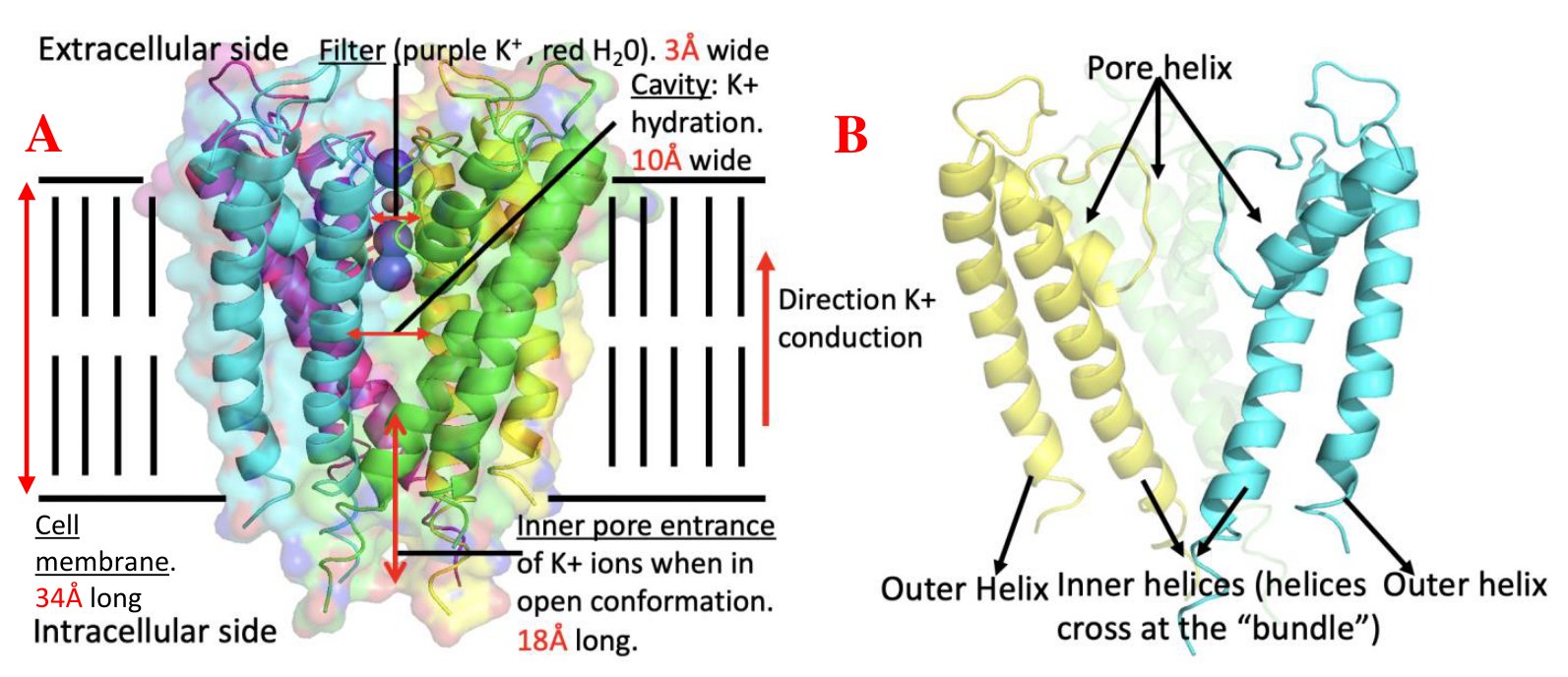
KcsA in the membrane with its pore dimensions (A), and with one subunit hidden to expose the pore helices and the helix bundle crossing (B).
The selectivity paradox
The channel selects potassium over sodium by roughly 10,000-fold while conducting at close to the diffusion limit, about 10^8 ions per second. Both halves of that are surprising together: a filter selective enough to reject an ion is normally slow. And the rejected ion, sodium, is the smaller one.
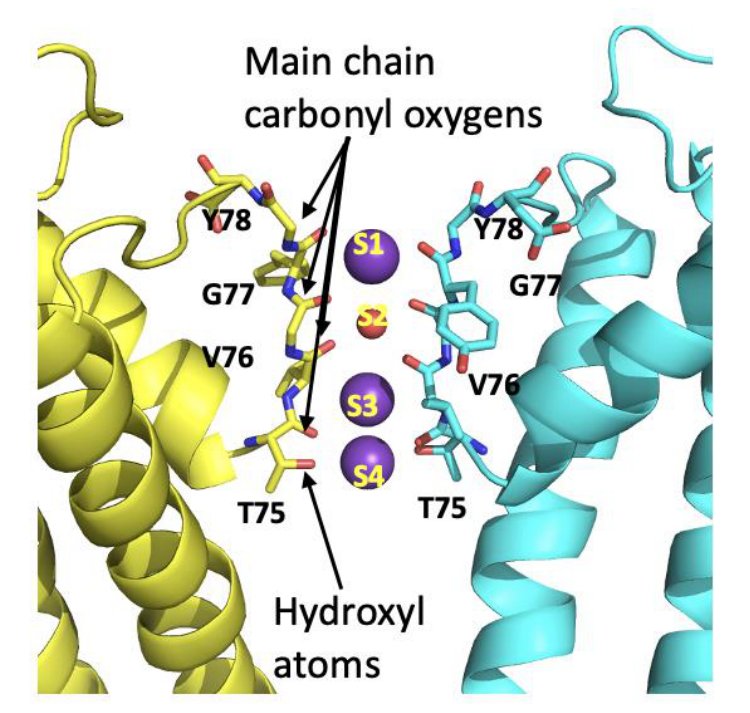
The selectivity filter: four potassium binding sites, S1 to S4, formed by backbone carbonyl oxygens and the Thr75 hydroxyl.
The resolution lies in the TVGYG signature sequence, conserved across prokaryotes, eukaryotes and archaea. Backbone carbonyl oxygens are spaced to mimic a potassium ion’s hydration shell almost exactly, so stripping the shell costs the ion almost nothing. Sodium is too small to contact all of them at once, so the cost of shedding its more tightly held hydration shell is never repaid. Selection is energetic, not a physical sieve, which is also why it can be fast.
Pore-helix dipoles stabilise potassium in the central cavity. Gating runs through a pH sensor and a glycine hinge, and the channel is blocked by tetrabutylammonium.