
DESeq2 Differential Expression and EMBOSS Needle Alignment on a HOXA1 Knockdown
Published:
A set of exercises spanning pairwise alignment, differential expression analysis and structured queries across the public genomics databases.
Pairwise alignment
A global alignment of two isoforms of a transcription factor in EMBOSS Needle returned 40.3% identity over 469 positions, 280 of which were gaps. The gaps are the result: one isoform lacks the DNA-binding domain entirely, and an alignment that scores poorly on identity is the thing that shows it.
Differential expression with DESeq2
DESeq2 run in Galaxy on count data from a HOXA1 knockdown in lung fibroblasts (Trapnell et al. 2012), three knockdown against three control. Of 19,808 genes, 7,797 were significant at adjusted p < 0.05, and 1,962 of those changed more than two-fold. PC1 separated the two groups and accounted for 96% of the variance.
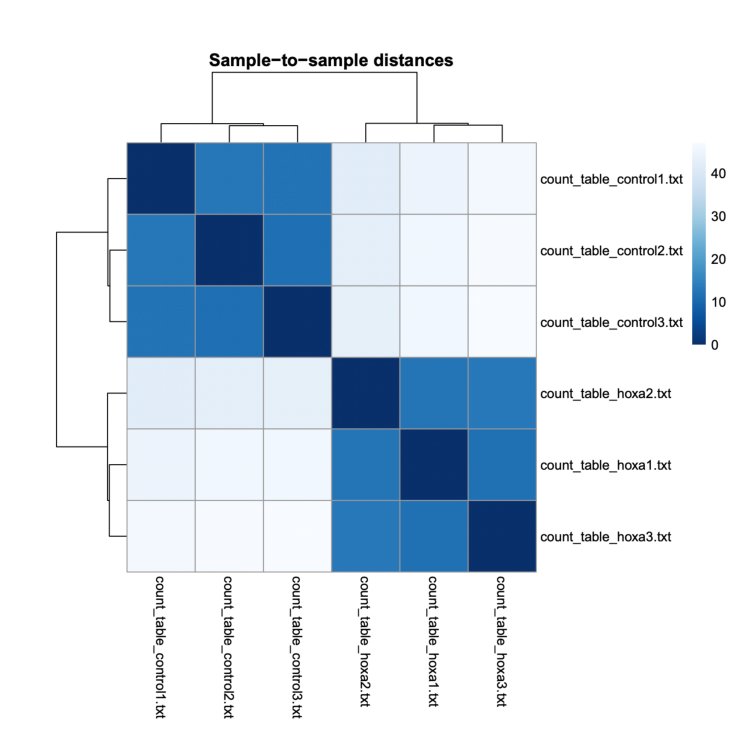
Sample-to-sample distances. Knockdown and control cluster apart, which is the check worth doing before trusting any gene-level result: if replicates do not group by condition, the differential test is describing something other than the condition.
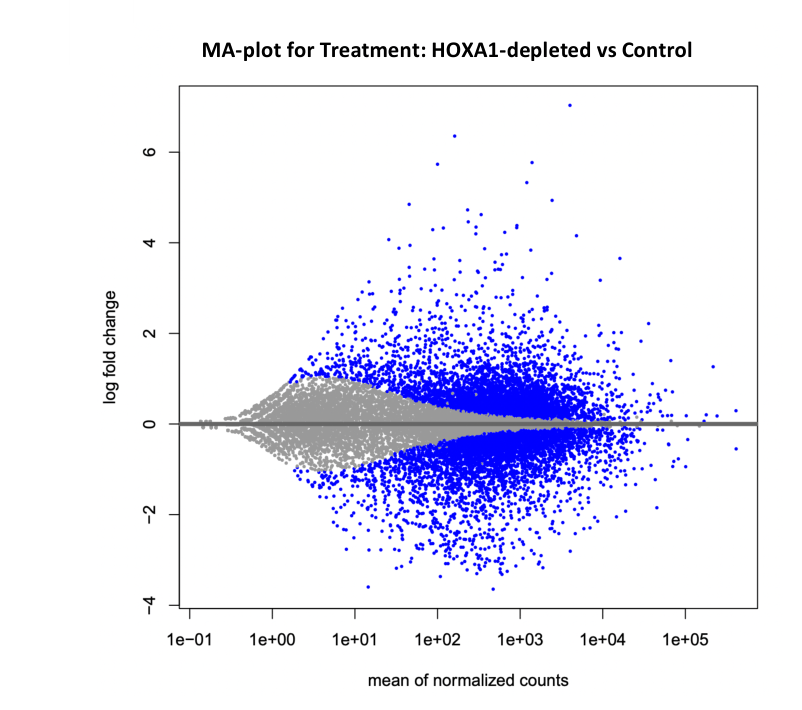
MA plot for the knockdown against control, significant genes in blue. Plotting log fold change against mean expression is what keeps the large fold changes at low counts in proportion.
Comparative genomics and cancer variants
- Ensembl. HORMAD1 across human, mouse and alpaca, with longest protein isoforms of 394, 392 and 392 amino acids, and the paralogue HORMAD2 present in all three.
- COSMIC and GDSC. EGFR variants, where L858R is the most frequently recorded EGFR mutation (count 7,965) and T790M is c.2369C>T, together with the associated drug sensitivity data for erlotinib, osimertinib, afatinib and gefitinib.