
APBS Electrostatic Mapping of Albumin Binding Sites and YASARA Docking of Gallic Acid
Published:
A structure-function study in PyMOL (cartoon, ribbon and surface representations, with the APBS plugin for electrostatics) and YASARA for docking. Structures: PDB 1AO6, 1E7H, 5IJF and 2BXG.
The paradox
Human serum albumin is 585 amino acids and 66.4 kDa, the most abundant protein in plasma. Its architecture is strikingly repetitive: three homologous domains, each split into subdomains A and B, 68% alpha helix across 28 helices and no beta sheet at all, held by 17 disulphide bonds plus a free Cys34, at a net charge of about -15 (pI 4.7).
A simple, repeated, uniformly negative structure should not be a general-purpose carrier. It is.
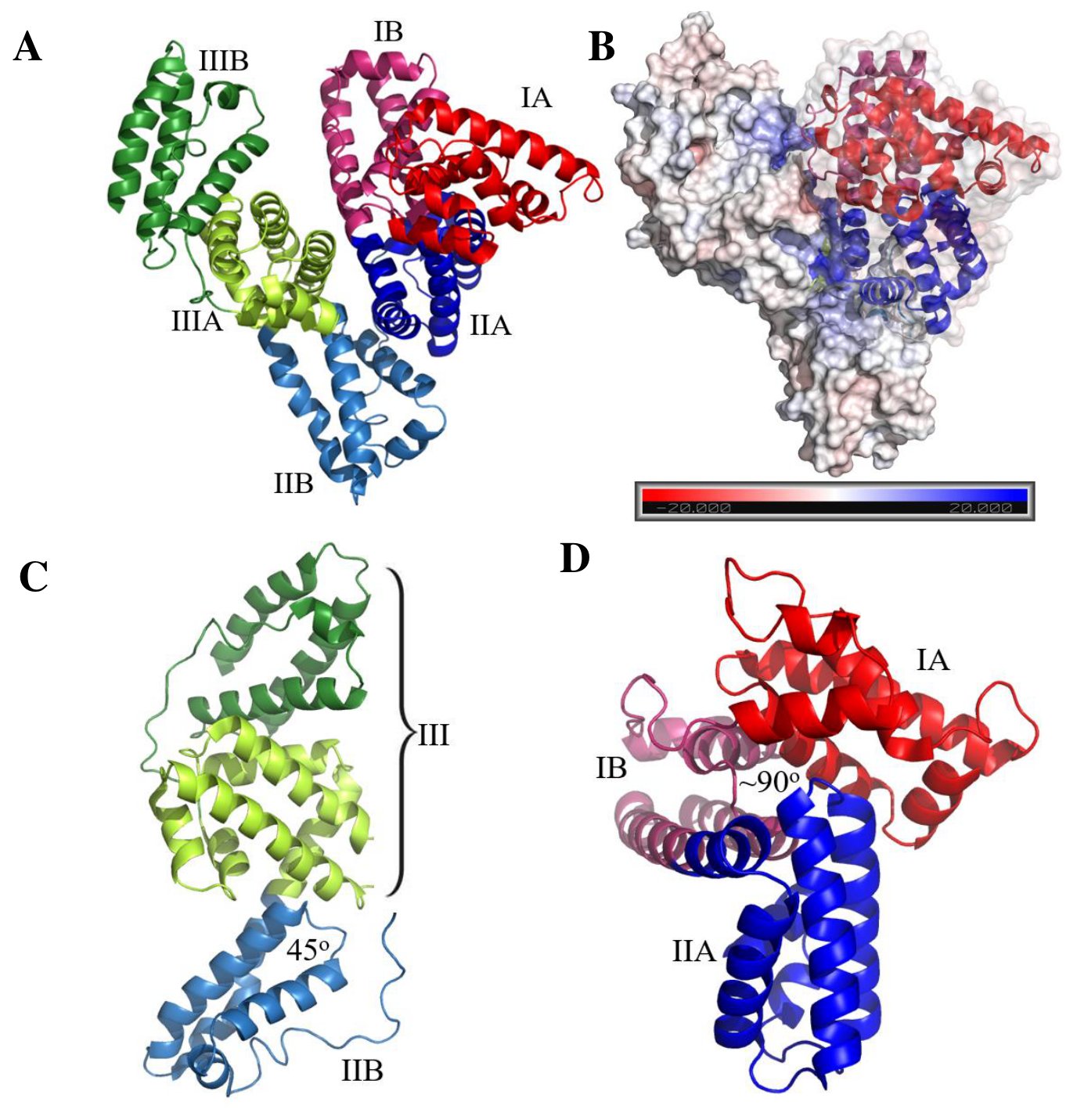
Human serum albumin in PyMOL: the six subdomains (A), surface electrostatics from APBS (B), and the Y-shaped (C) and T-shaped (D) domain junctions. The resolution to the paradox is in C and D. Duplicating one domain three times and arranging the copies asymmetrically produces pockets of differing character without inventing new architecture.
Seven fatty acid sites
The fatty acid sites FA1 to FA7 include the classical drug sites Sudlow I and II. Palmitate in FA1 is anchored by Tyr161, Leu182, Arg117 and a bridging water, and a salt-bridge strap from Arg209 holds the fatty acid in FA6.
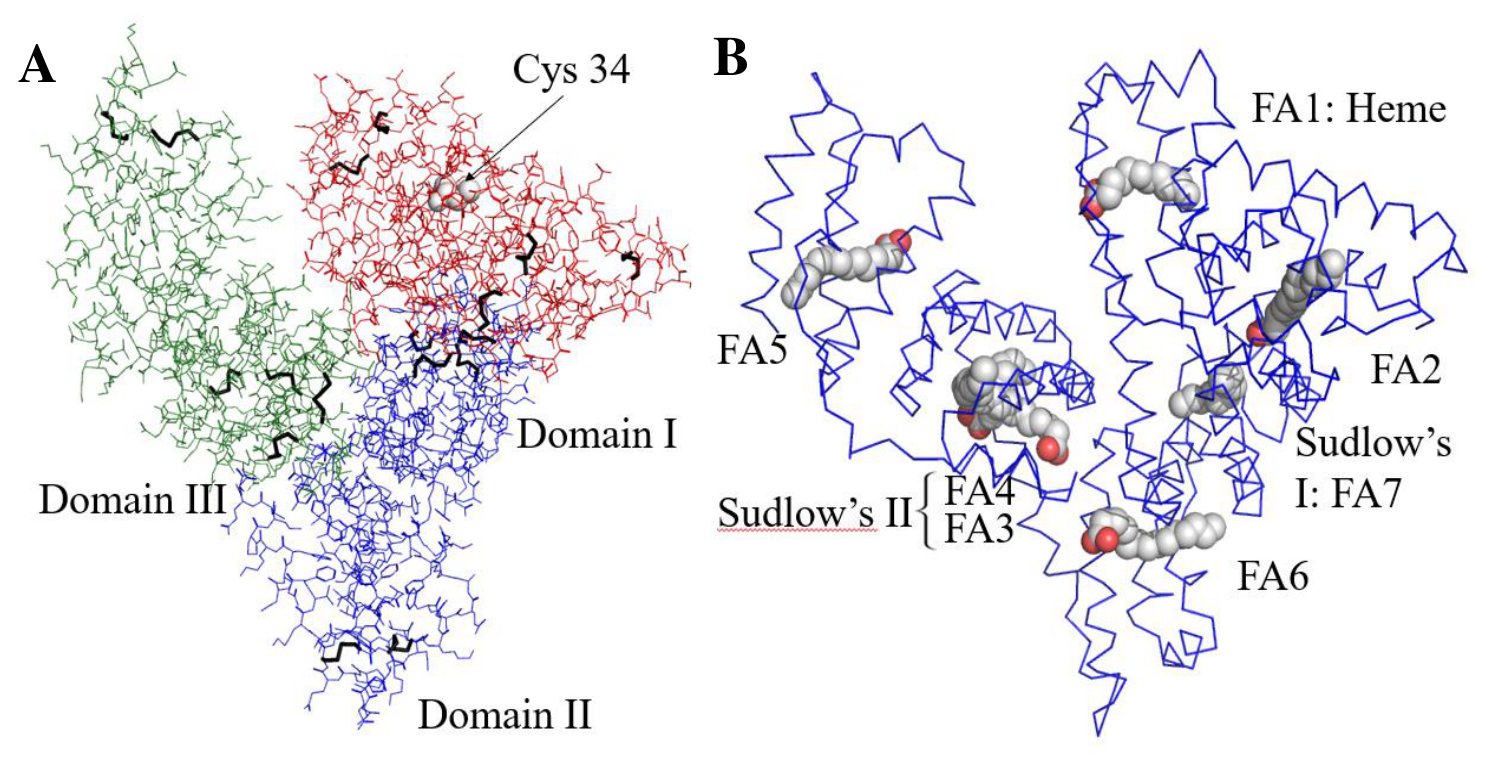
The 17 disulphide bonds and the free Cys34 (A), and fatty acids occupying the seven fatty acid sites including the drug sites Sudlow I and II (B).
Metal binding adds the N-terminal site, Cys34, and site A, where His67, Asn99, His247 and Asp249 coordinate zinc, with a site B that has never been located. Ibuprofen binds at FA3/4 and FA6.
Docking gallic acid
Gallic acid is a dietary phenolic acid from tea and fruit, absorbed in the intestine and carried by albumin. Built from a SMILES string and docked into ligand-free HSA in YASARA, it sits in subdomain IIA about 10 Angstroms from Trp214, contacting Tyr150, Arg222, Arg257, Leu219, Leu238 and Ala261.
The proximity to Trp214 is what makes the interaction experimentally tractable. Albumin has a single tryptophan where a protein of its size would usually have several, so there is one intrinsic fluorescence signal, and quenching on binding reports on that site specifically rather than averaging over many.
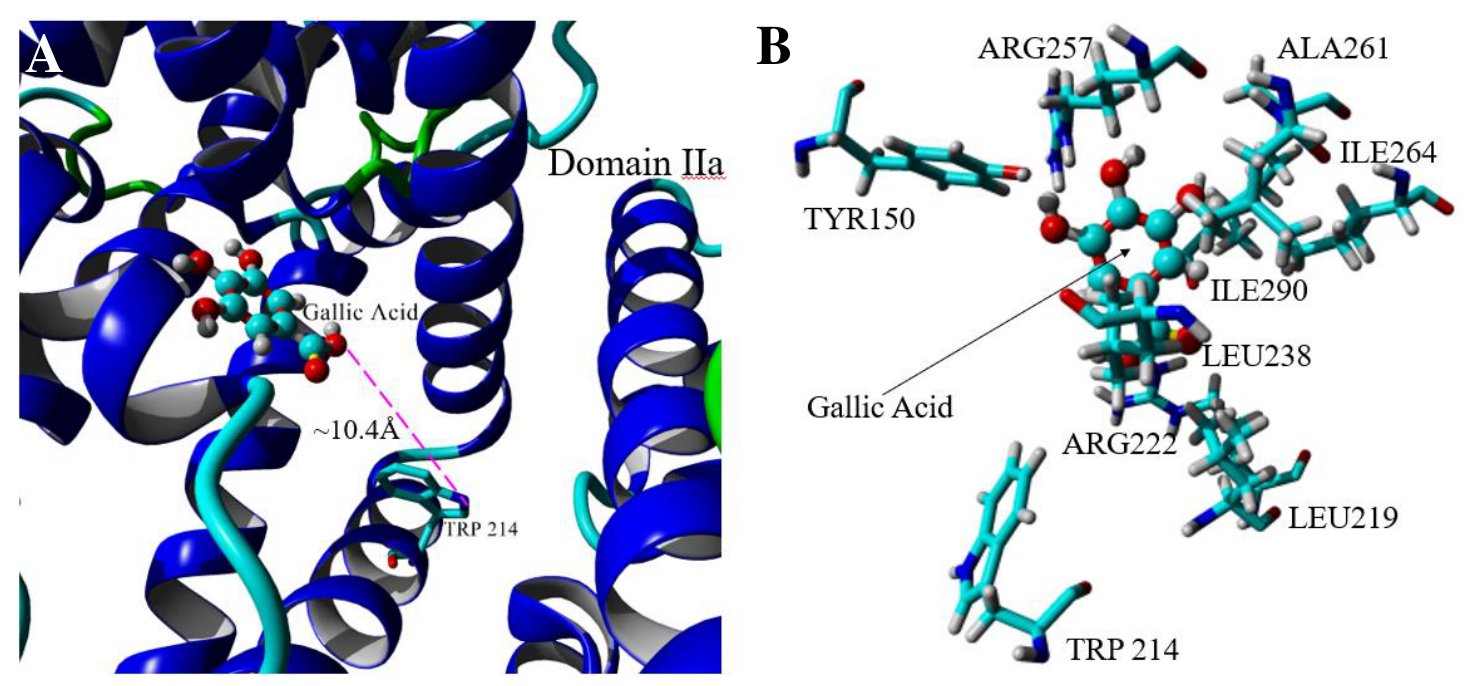
Gallic acid docked into subdomain IIA in YASARA (A) and the residues surrounding it (B).