DeepTMHMM, PSI-BLAST, InterPro and AlphaFold Annotation of an Unknown Sensor Kinase
Published:
An unknown protein of about 460 residues, to be annotated from its sequence alone: topology, homologues, domains and predicted structure, ending in a single annotation that all of the evidence supports.
Topology
DeepTMHMM predicted two transmembrane helices, at residues 22 to 41 and 172 to 189, with an extracellular region between them and both termini inside the cell. PHOBIUS agreed to within a few residues. Two independent predictors converging is worth more than either one alone.
Homologues, and what a profile search buys you
BLASTp returned sensor kinases such as CarS and PhoQ. Two iterations of PSI-BLAST returned MprB signal-transduction histidine kinases instead, and the comparison is the instructive part:
| BLASTp | PSI-BLAST | |
|---|---|---|
| Mean -log10 E-value | 44.74 | 117.51 |
| Query cover | 68% | 94% |
| Sequence identity | 33.3% | 21.7% |
PSI-BLAST finds hits that are far more significant and cover far more of the query, at lower sequence identity. That is exactly what a profile search is for: after the first iteration it searches with a position-specific scoring matrix built from the hits, so it matches conserved positions rather than overall similarity, and reaches homologues too distant for a pairwise search to see.
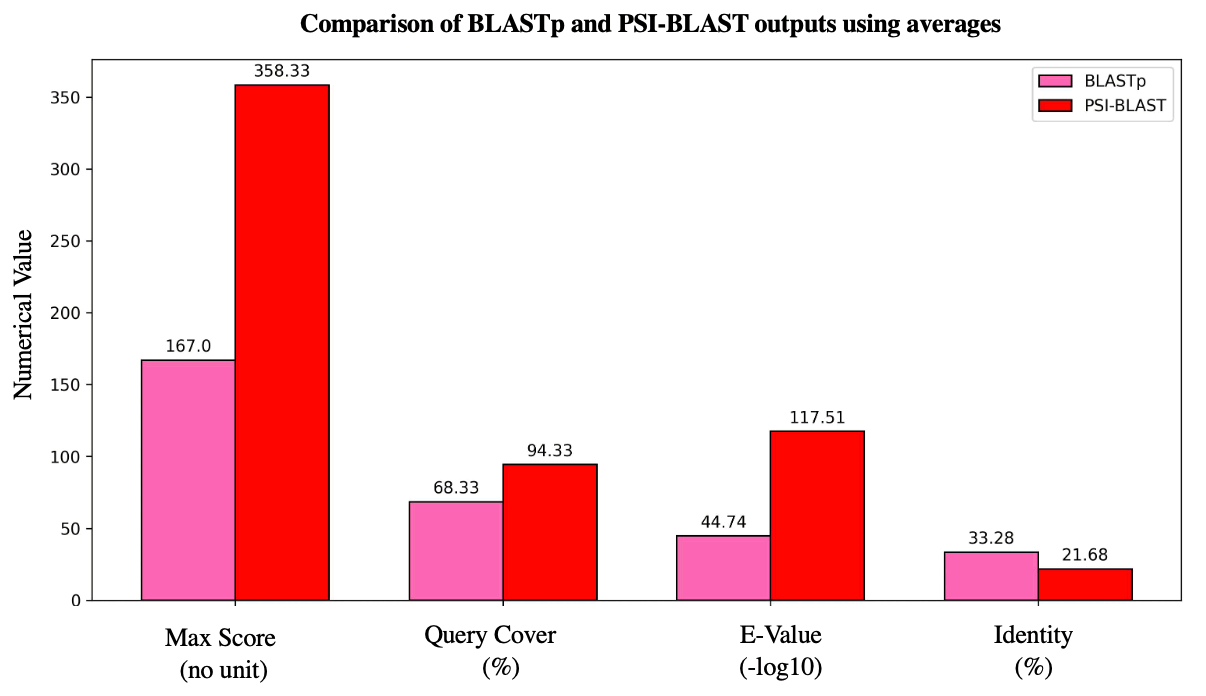
Annotated search output: the profile search finds more distant homologues, with lower E-values and higher query cover but lower identity.
Domains
InterPro found four features: a HAMP domain (192 to 243) sitting immediately before a histidine kinase domain (251 to 453), with an HSP90-like ATPase region (348 to 451) and two C-terminal signal transduction motifs.
The arrangement is the answer. A HAMP domain is the linker that transmits a conformational change from a transmembrane helix to a cytoplasmic signalling domain, so finding one wedged between the membrane helices and the kinase domain says this protein is built to pass a signal inward across the membrane.
Structure
Phyre2 returned ten models above 99.9% confidence at 17 to 26% identity, comfortably over the 15% threshold for accepting a model, and every template was a kinase or sensor protein. But the models covered only about residues 190 to 450, leaving the transmembrane and extracellular parts unmodelled, because there were no templates for them.
AlphaFold covered the whole chain, with pLDDT above 90 across both transmembrane helices and the kinase domain, dropping only across the first 20 residues. It agreed with Phyre2 on the kinase fold and supplied the parts template-based modelling could not reach.
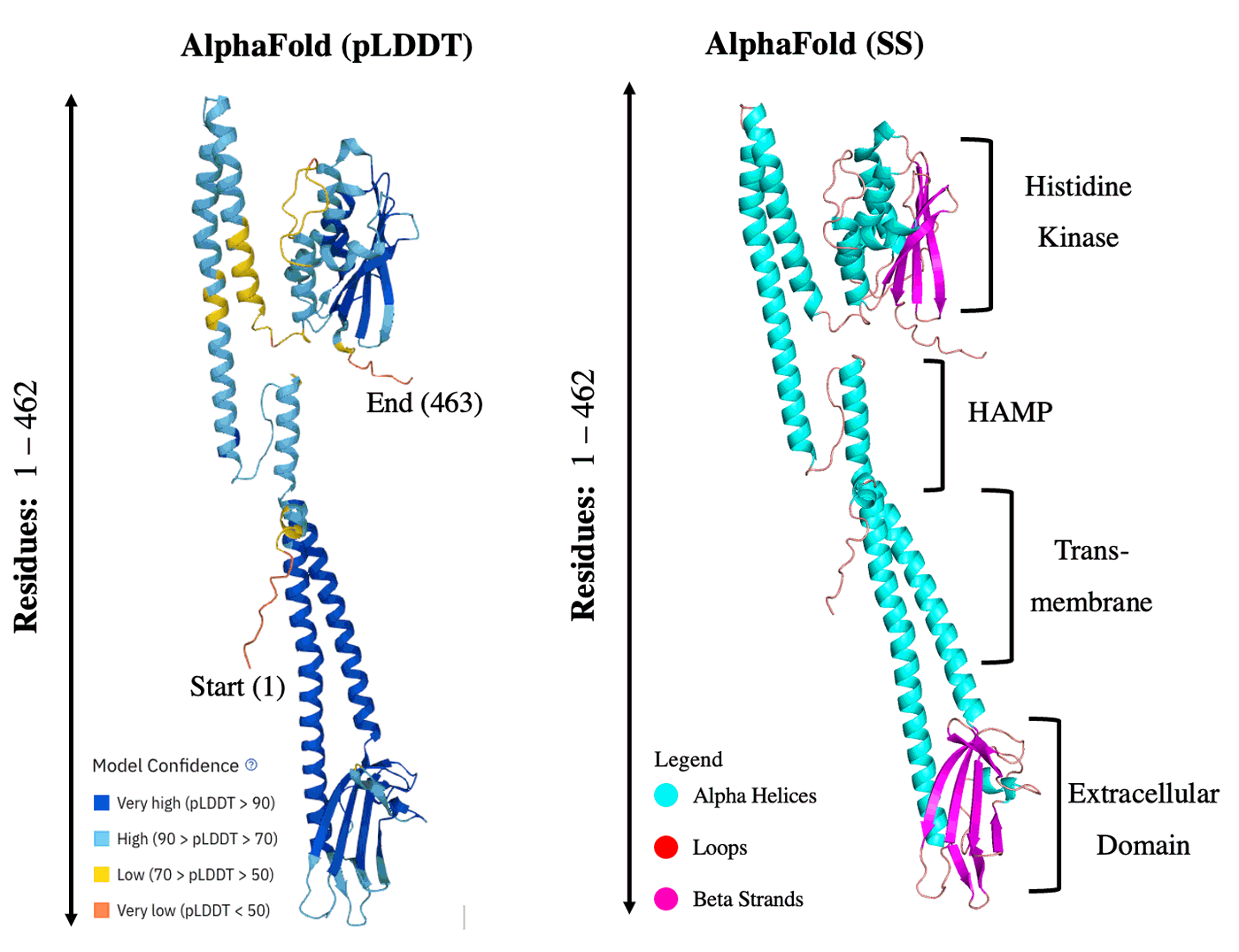
The AlphaFold model coloured by confidence (pLDDT) and by secondary structure. Reading the confidence colouring first is the discipline: the low-confidence N-terminus is a disordered tail, not a structural claim.
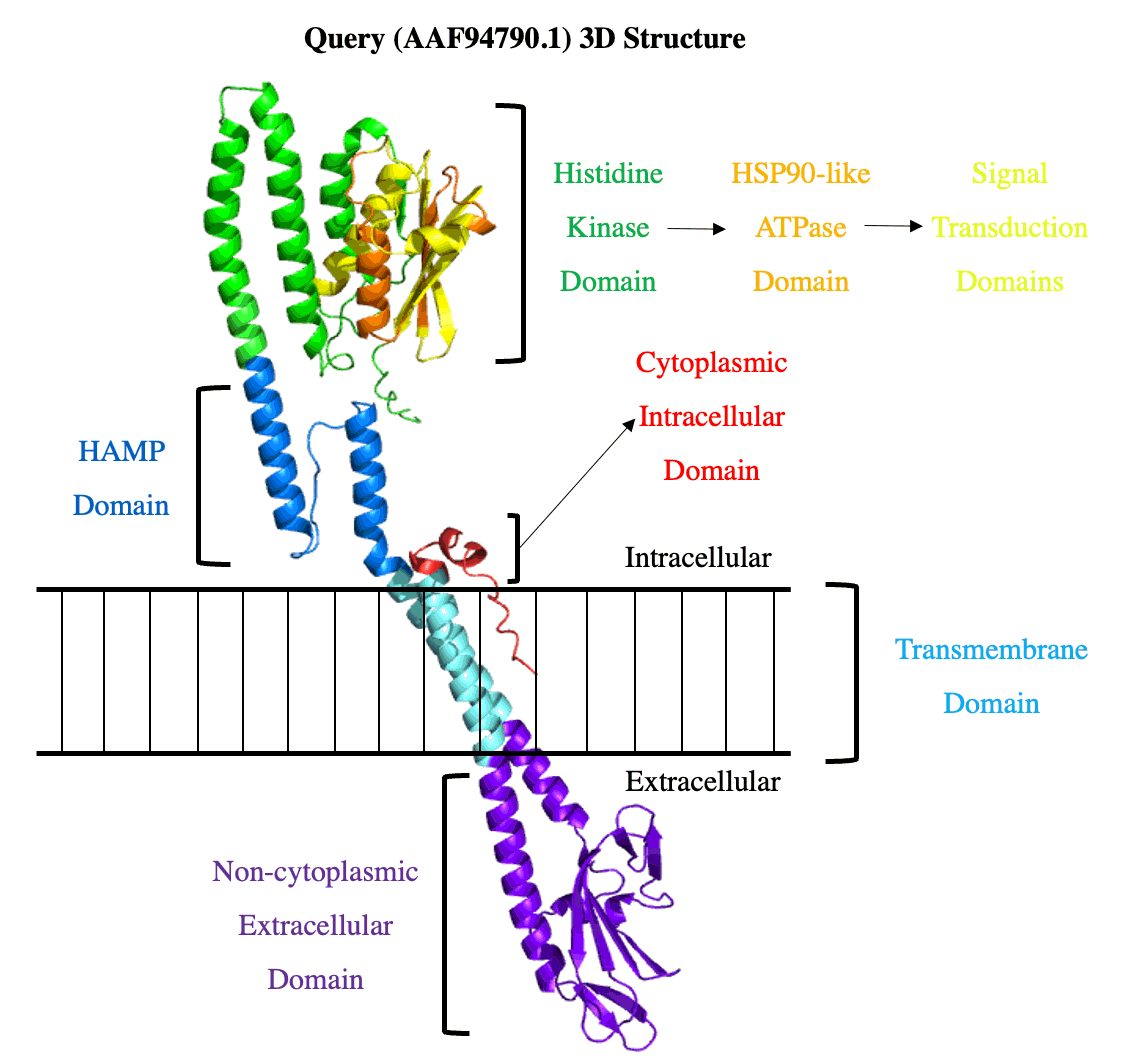
The model placed in the membrane with the transmembrane, HAMP, kinase and extracellular domains labelled. Every label traces back to a separate line of evidence: topology from DeepTMHMM and PHOBIUS, domains from InterPro, fold from Phyre2 and AlphaFold.
Final annotation
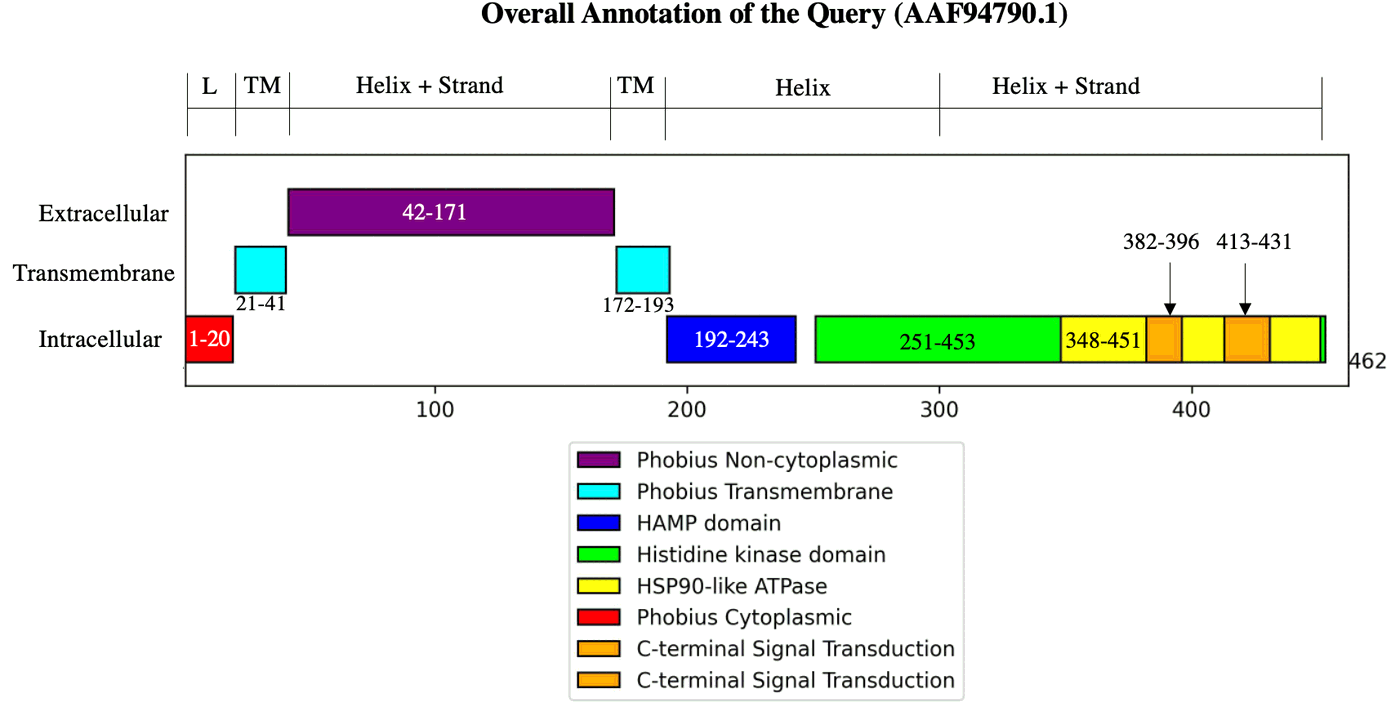
The final annotation along the chain: topology, domains and secondary structure, combining PHOBIUS, InterPro and the BLAST searches into one map. Drawn in matplotlib.
A gram-negative bacterial sensor histidine kinase from a two-component system, with the domain order of the canonical E. coli EnvZ architecture: sense a stimulus outside the membrane, pass the conformational change through HAMP, autophosphorylate on the kinase domain inside.
This is a coursework annotation of a set sequence, inferred from prediction rather than experimentally validated.