
RepeatMasker, BLAST and Ab Initio Gene Prediction on an Unknown Fungal Contig
Published:
An unknown 13.84 kbp fungal contig, with the task of finding its repeats, identifying the organism, predicting its genes with two independent programs, and combining the evidence into a putative gene model.
Repeats first, and why the order matters
RepeatMasker found 3 LINEs and 2 LTR elements covering 7.97% of the sequence, plus 21 unclassified repeat families covering a further 35.13%. Close to half the contig is repetitive.
That is not a side observation, it changes the answer. BLASTn on the raw sequence placed every significant hit in Blumeria graminis, powdery mildew, with the single closest identity match to the hordei forma specialis. Re-running BLASTn on the repeat-masked sequence, roughly 7,500 nt of the original 13,800, removed the hordei hits entirely and left one tritici genome assembly alignment covering 90% of the sequence at 92% identity.
The hordei match was repeat-biased: shared transposable elements rather than shared ancestry at this locus. Masking before searching is the difference between the right answer and a confident wrong one.
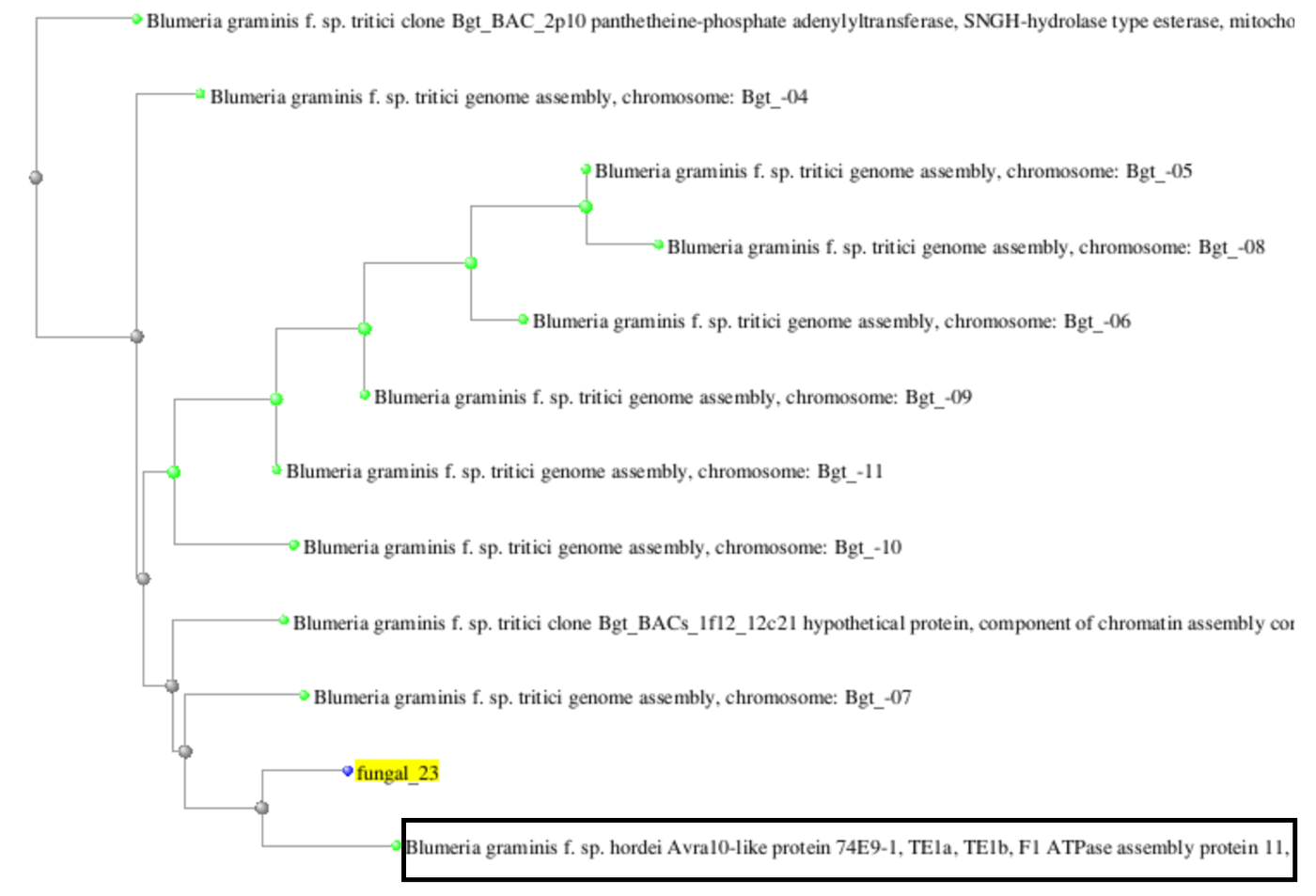
Annotated BLASTn output: the query sits among *Blumeria graminis genome assemblies, closest to the hordei forma specialis before masking. After masking, that proximity disappears.*
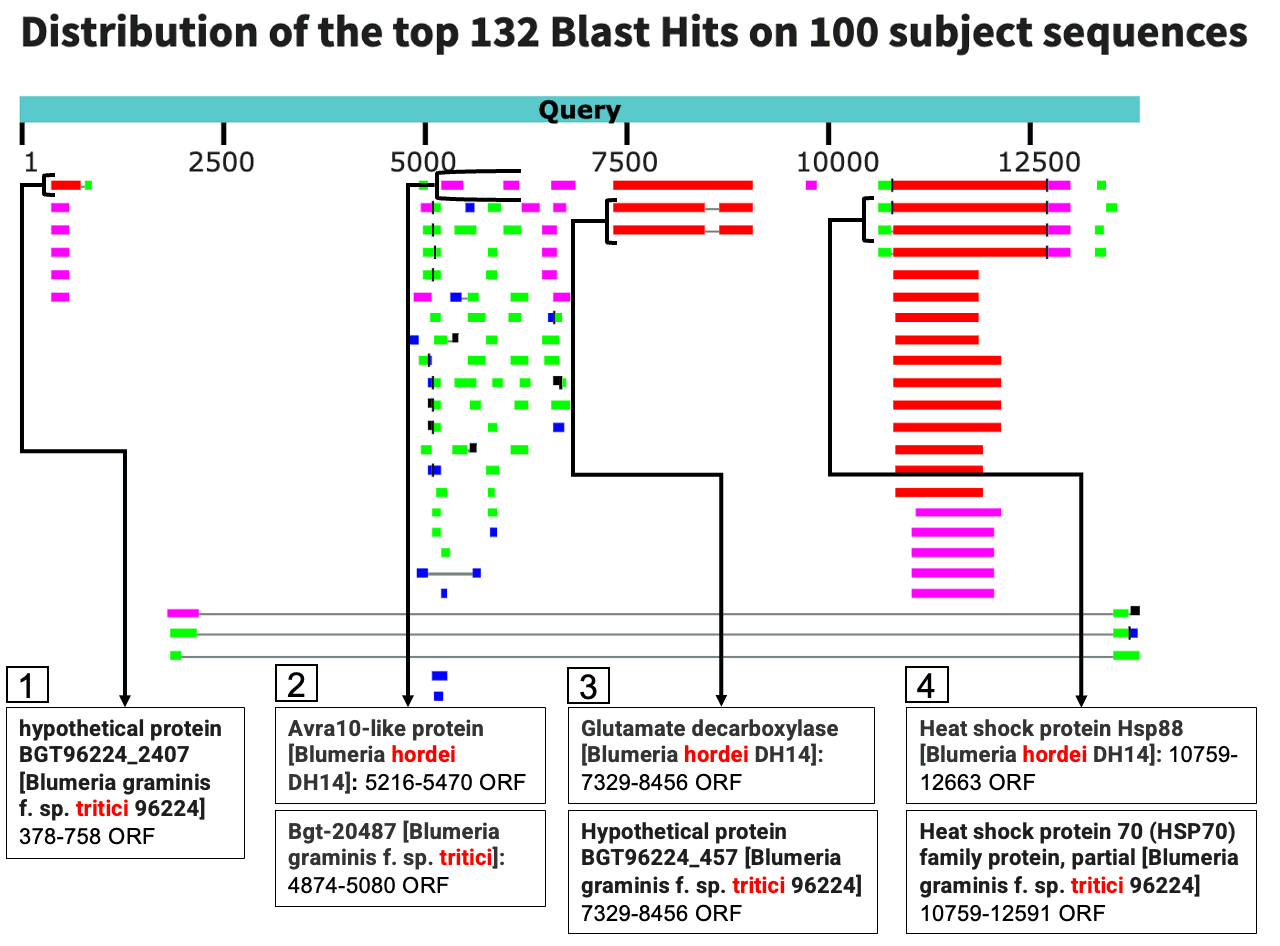
Annotated BLASTx output: where the 132 top hits fall along the contig, labelled with the four proteins they point to and their reading frames. Within the genus, *hordei scored highest but on far fewer alignments, and the tritici equivalents were mostly annotated as hypothetical proteins.*
Two gene predictors, and why they disagree
AUGUSTUS has no Blumeria training set, so it was run with the closest available species on its fungal tree, Botrytis cinerea. It predicted 4 genes, 7 transcripts and 32 exons.
FGENESH does have B. graminis parameters, and predicted 5 genes and 13 protein-coding exons.
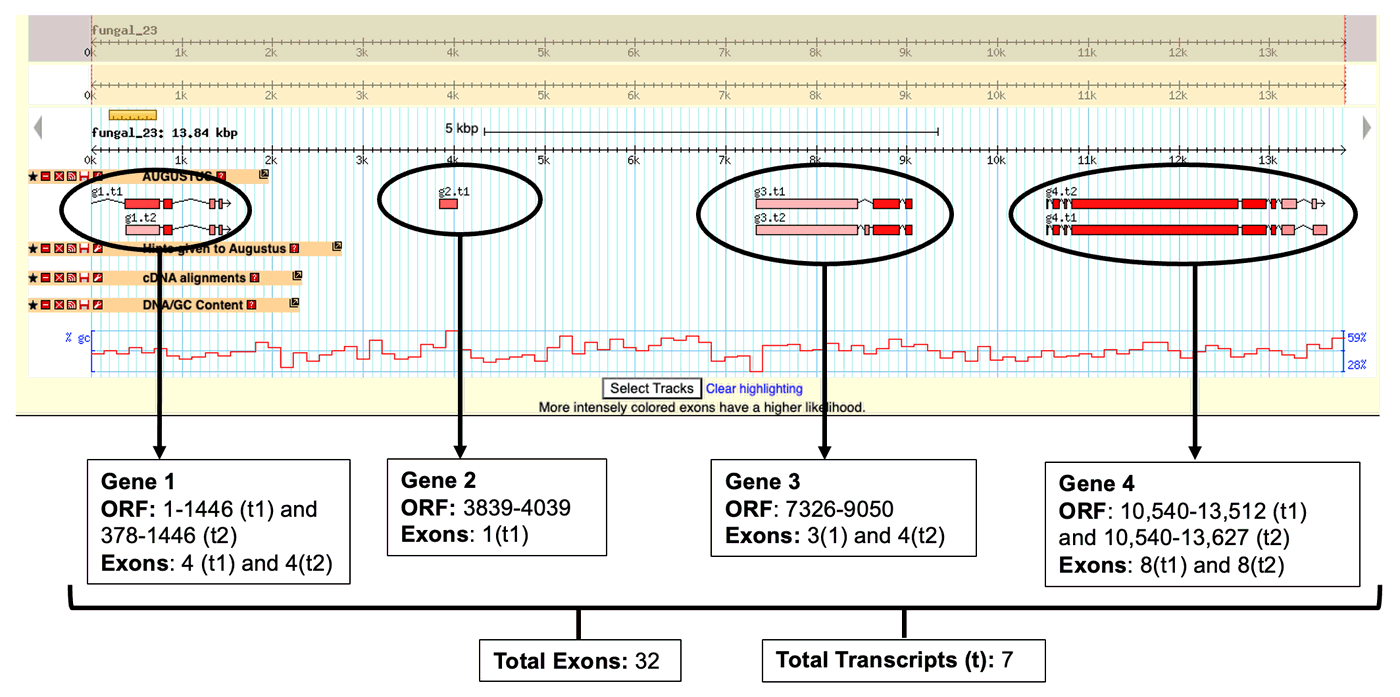
Annotated AUGUSTUS output in the genome browser, labelled with each prediction’s reading frame and exon count. Trained on a related species rather than this one, it fragments the sequence into many more exons and alternative transcripts.
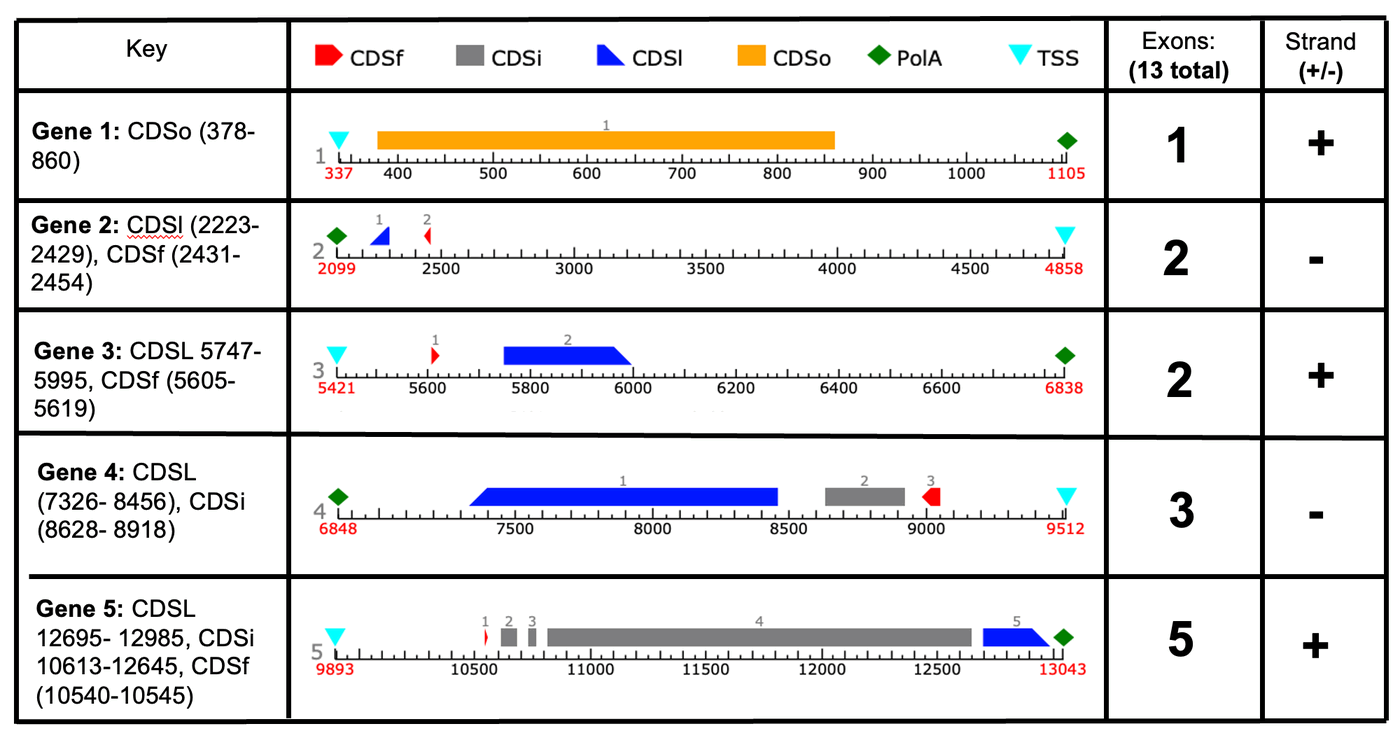
FGENESH output: five genes with their exon structures, coding strand and exon counts. One transcript per gene, and open reading frames that line up with the BLASTx alignments.
FGENESH was the better predictor here, for a reason worth stating plainly: species-specific parameters. Ab initio prediction learns what a gene looks like in a particular genome, so a model trained on the right organism beats a more general one, and 32 exons across 7 transcripts is the signature of a model guessing at splice sites it was never taught.
The putative gene model
Combining the predictions with BLASTx evidence, and excluding anything falling inside a repeat, gave three features with E-values near zero and over 90% identity: two hypothetical proteins (BGT96224_2407 and BGT96224_457, the latter matching glutamate decarboxylase in hordei) and a heat shock protein 70 family protein.
This is a coursework conclusion on a set sequence, so the model is putative rather than a validated annotation.