Half-Life: Predicting Which Research Ideas Compound and Which Fade
Published in Vela Partners, 2026
Every hype cycle produces hundreds of “next big things”. Most fade within two years. A few, such as transformers and GRPO, become the foundation of a field and of the companies built on it. The usual way to tell them apart is momentum: how fast something is growing. But in their first months, a durable idea and a spike look identical.
Half-Life reads a research theme’s first months and predicts whether it will still be growing two years later.
| Result | |
|---|---|
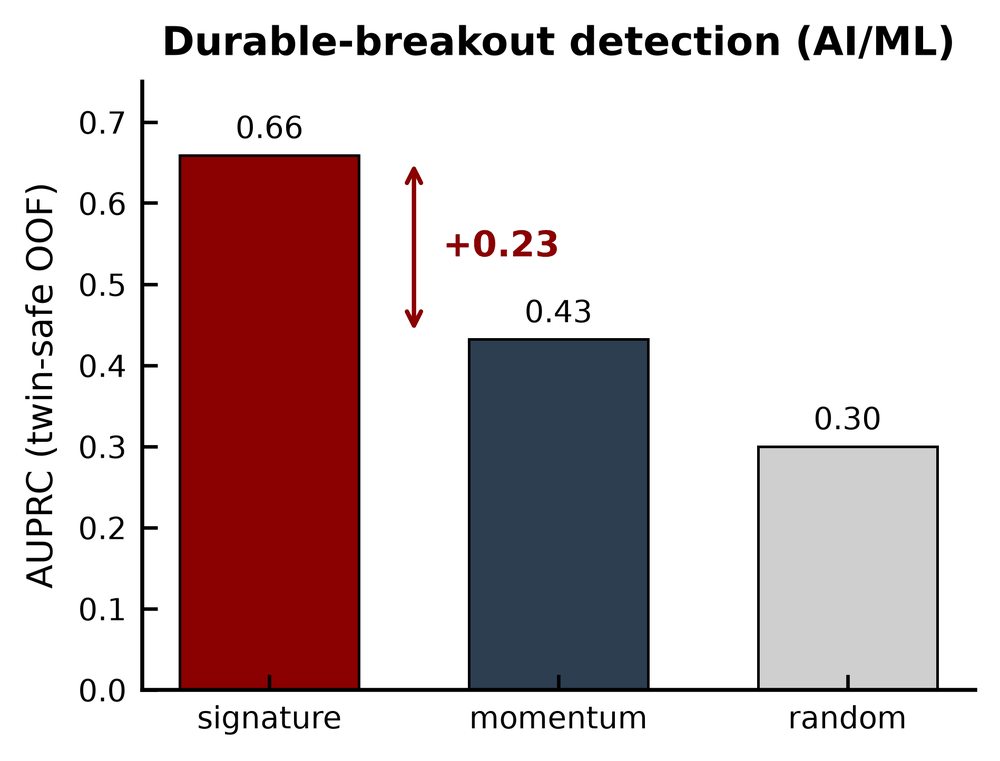
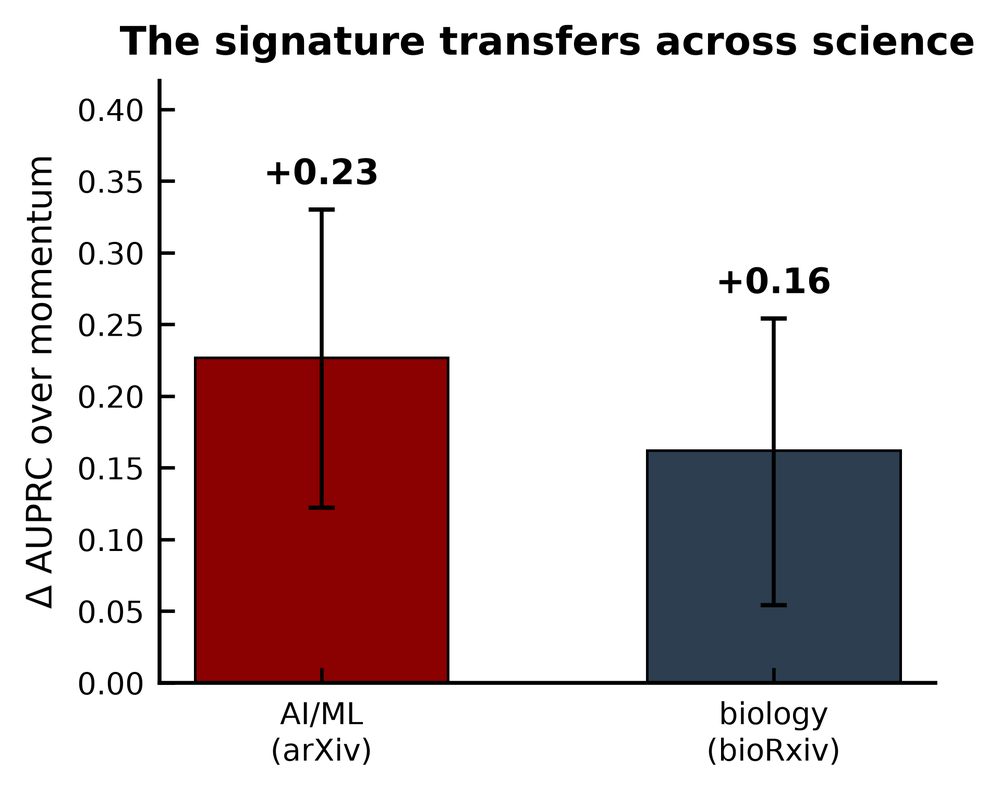
| +0.23 AUPRC over momentum | durable vs fad across 383 AI/ML research themes, 95% CI [+0.12, +0.33], p < 0.001 |
| 6 / 6 | pre-registered cross-field predictions correct |
| +0.16, p = 0.002 | transfers unchanged to biology (263k bioRxiv preprints) |
| Momentum subsumed | adding momentum to the model adds nothing on top |
| 0 look-ahead | every datum carries the date it became public; a leakage test gates every build |
The pipeline
- Collects papers and eight other alternative-data sources, storing each record with the date it became public.
- Detects new research themes as they emerge, month by month.
- Measures each theme as it looked at the time: how persistently it appears, how many independent groups adopt it, how fast it grows, how widely it spreads.
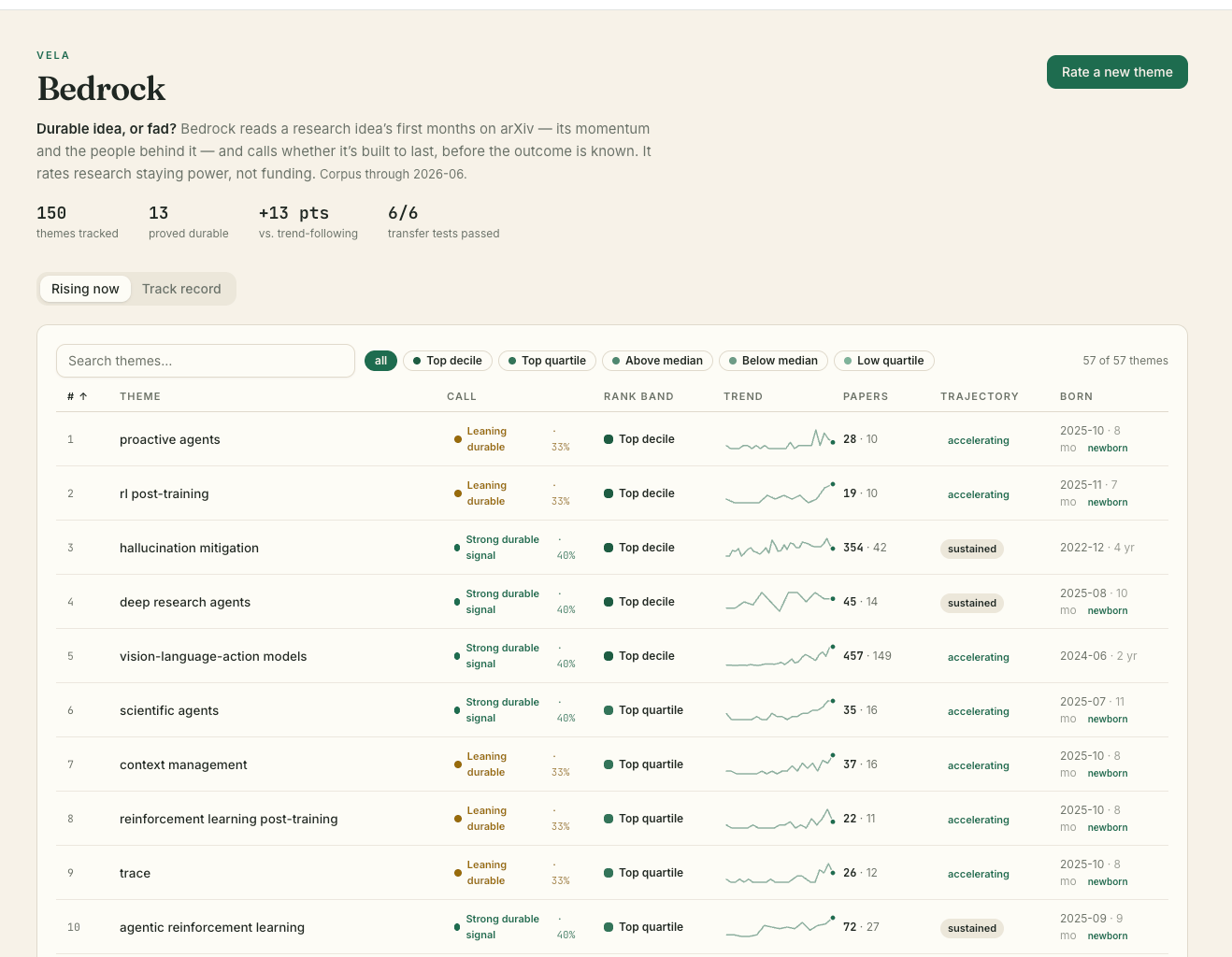
- Predicts durable vs fad, and reports the theme’s current trajectory (accelerating, sustained, cooling, faded) and the researchers driving it.
Quant methodology
The project applies quant-finance backtesting discipline to research and alternative data. Each control is enforced in code, not merely described:
- Point-in-time data (the ALFRED / real-time data approach). Every record carries a
reference_date(what it is about) and aknowledge_date(when it became public). A month-T query sees nothing published after T. - A leakage canary:
check_no_future_leakageruns on every panel build and fails it on any violation. - Survivorship-free universes: failed markets and dead ideas stay in every month’s universe.
- Look-ahead leak hunting: arXiv venue and institution fields turned out to be backfilled after acceptance, and were removed.
- Pre-registration: hypotheses, thresholds and all six field predictions were fixed before scoring.
- Placebo and permutation tests: label-shuffle placebos and stratified permutation nulls, to rule out lift from a bug or from sector/year composition.
In production at Vela
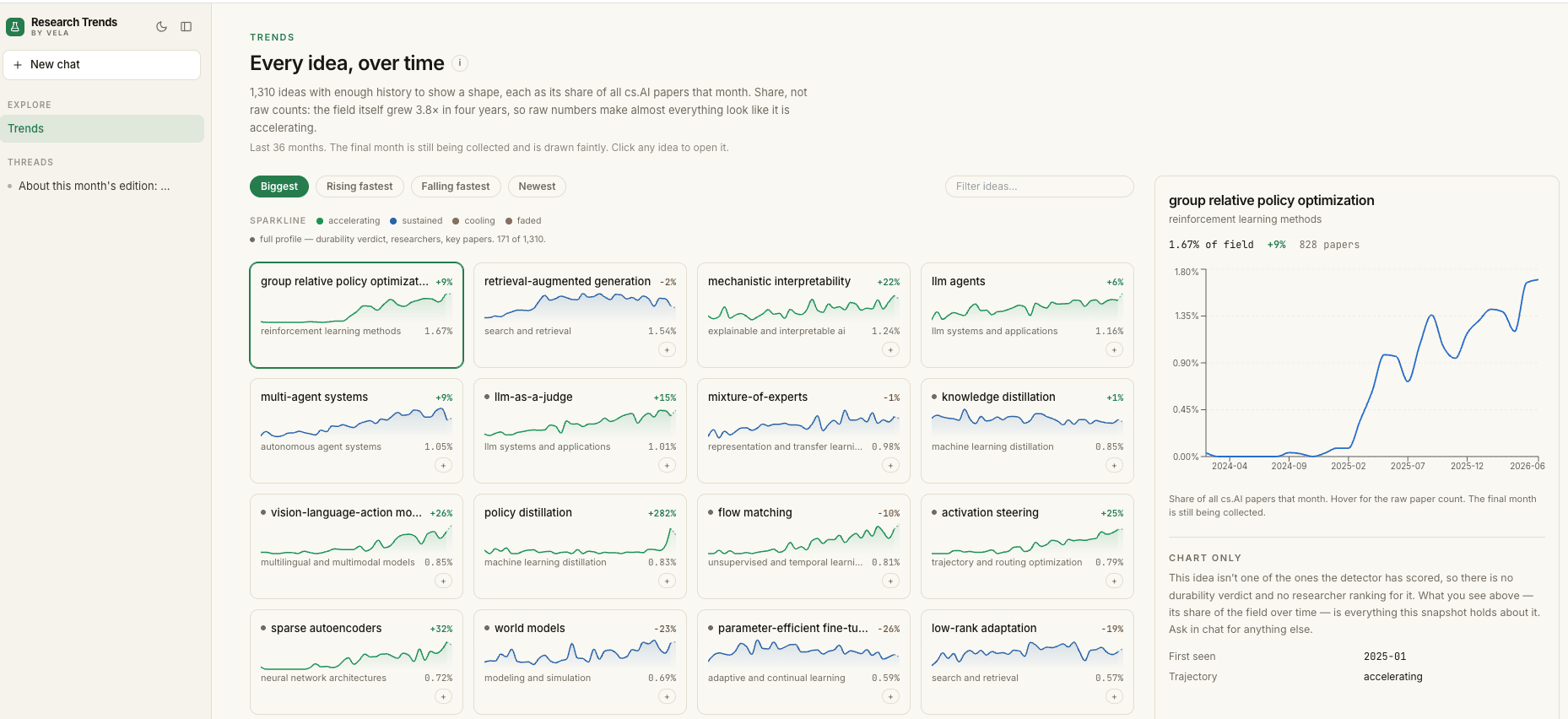
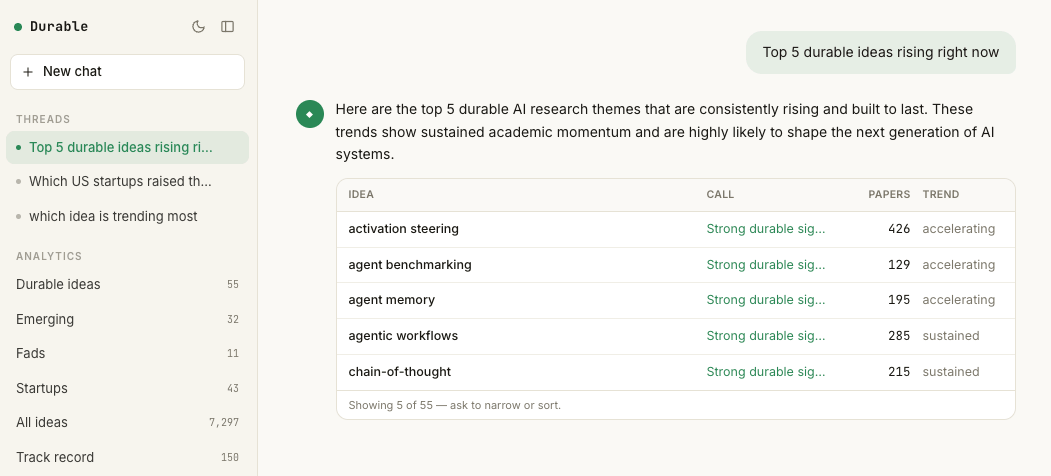
Vela Partners now runs an extended version in house as a monthly research-trends product: every idea in the field plotted as its share of papers over time, with a durability verdict, trajectory and the researchers behind it.