
Phred+64 FASTQ Filtering and IUPAC Regex Motif Search in Core Python
Published:
Two sequence-processing exercises with third-party libraries restricted, BioPython and PyCogent banned by name, so everything had to be written from first principles with core Python and the re module.
Paired-end FASTQ quality filtering
Read a paired-end Illumina FASTQ file, decode the quality string, and split the read pairs by average quality: pairs where both reads average Q30 or above to one file, pairs where either read falls below to another. On the sample file, 69 of 94 pairs were kept and 25 filtered.
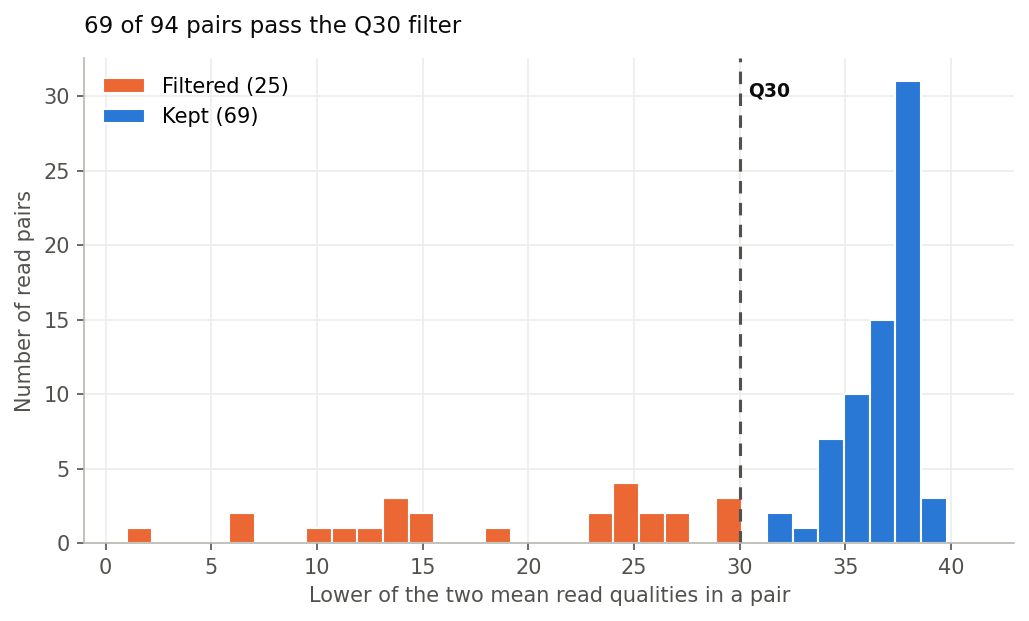
Every read pair in the sample file by its weaker read. The split is clean rather than marginal: the kept pairs cluster around Q35 to Q38 while the filtered ones spread from Q1 to Q30, so the threshold is not cutting through a dense part of the distribution.
Filtering by pair rather than by read is the other constraint: the two files have to stay in step, so a read whose mate fails goes with it. That is why the plot keys each pair on its weaker read.
The detail that decides whether this works at all is the encoding. Quality is not stored as numbers but as ASCII characters, and this file used Phred+64 rather than the now more common Phred+33. Assume the wrong offset and every score is out by 31, which is the difference between keeping a read and discarding it: decoded as Phred+33 this file has no failing pairs at all, and the filter silently does nothing.
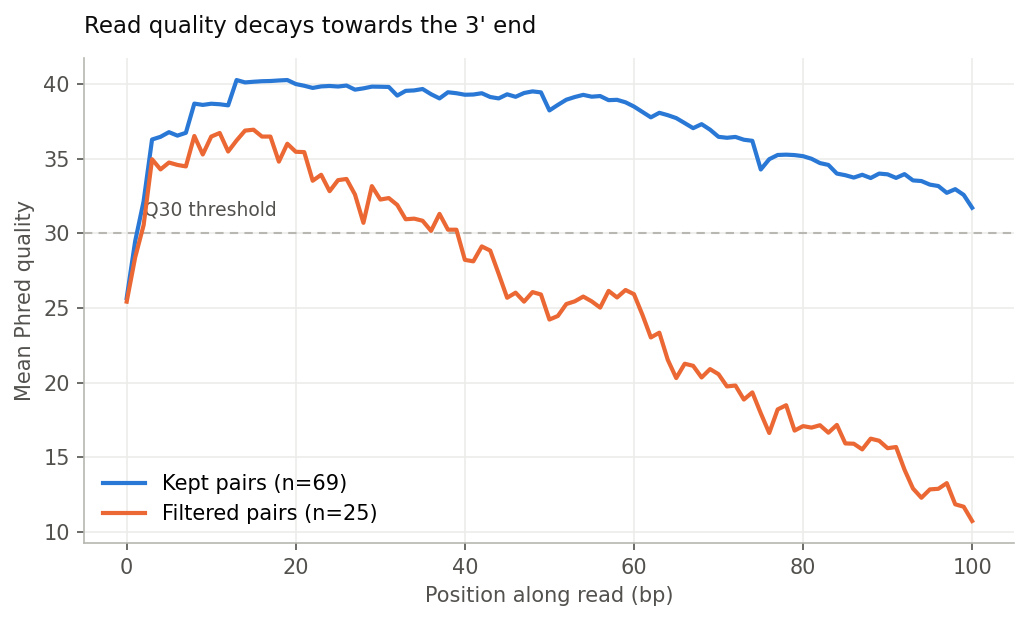
Mean quality along the read. Both groups decline towards the 3’ end, which is a property of the sequencing chemistry rather than of these particular reads. The filtered pairs start lower and fall faster, so the failure is whole-read rather than a bad tail.
Filtering by pair rather than by read is the other constraint: the two files have to stay in step, so a read whose mate fails goes with it.
Motif searching with regular expressions
Search FASTA sequences for transcription factor binding motifs written in IUPAC ambiguity codes: RUNX1 BHTGTGGTYW, TGIF1 WGACAGB and IKZF1 BTGGGARD.
Each ambiguity code translates to a regex character class, so B becomes [CGT], W becomes [AT], and the motif becomes a pattern. This is what regular expressions are for: a binding site is a consensus with degenerate positions, not a fixed string.
Binding sites also occur on either strand, so each sequence is searched again via its reverse complement, with hits mapped back to forward-strand coordinates so both sets are reported in the same frame. Each hit is reported with its factor, start and end, matched bases and strand, and the parser handles any number of motifs and sequences.
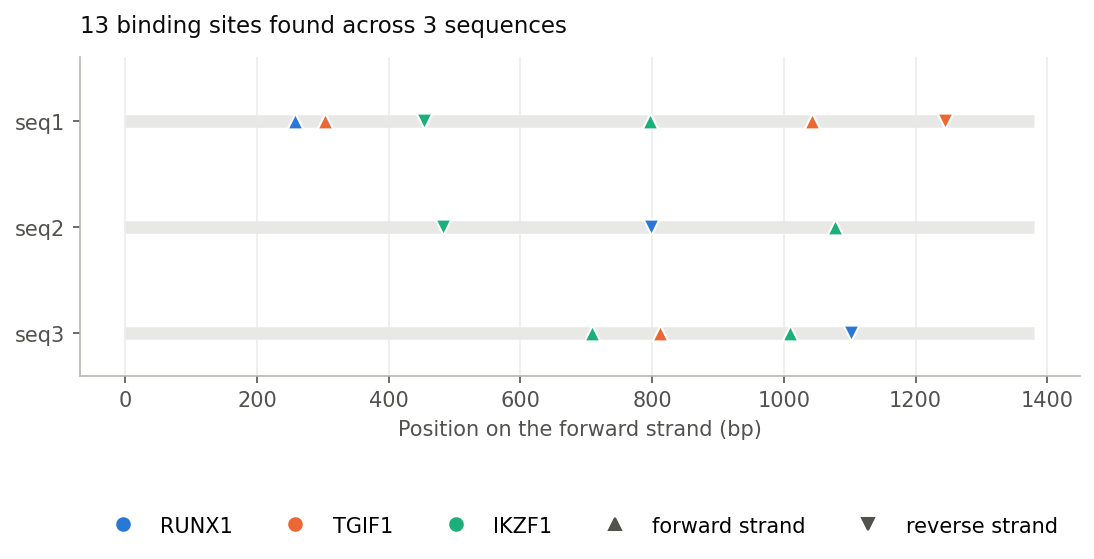
The 13 sites the search returns across the three sequences. Five of them are on the reverse strand and would be missed entirely by a forward-only search, which is the reason the reverse complement pass is not optional.