
SWISS-MODEL and AlphaFold2 Homology Modelling of CTRL-1, Validated with QMEAN and MolProbity
Published:
P40313, human chymotrypsin-like protease CTRL-1, has no experimentally solved structure. The problem: build one from sequence alone, three different ways, then work out which of the three to trust. The target is 264 amino acids, 28.0 kDa.
Finding templates
SWISS-MODEL returned bovine chymotrypsinogen A templates 2cga.1.A and 1p2m.3.C at 53.88% identity (1.8 and 1.75 Angstrom resolution, GMQE 0.79 and 0.81). A separate BLAST search against the PDB found 1ACB_E, bovine alpha-chymotrypsin in complex with eglin c, at an E-value of 1e-72 with 93% coverage and 53.66% identity, chosen over 1DLK_B for its better coverage. A T-Coffee alignment of query against templates scored 993 for consistency.
Three models, compared
Two homology models were built, one automated from 1p2m.3.C and one alignment-based from 1ACB_E, and compared against an AlphaFold2 model whose low-confidence signal peptide (residues 1 to 18) was removed first.
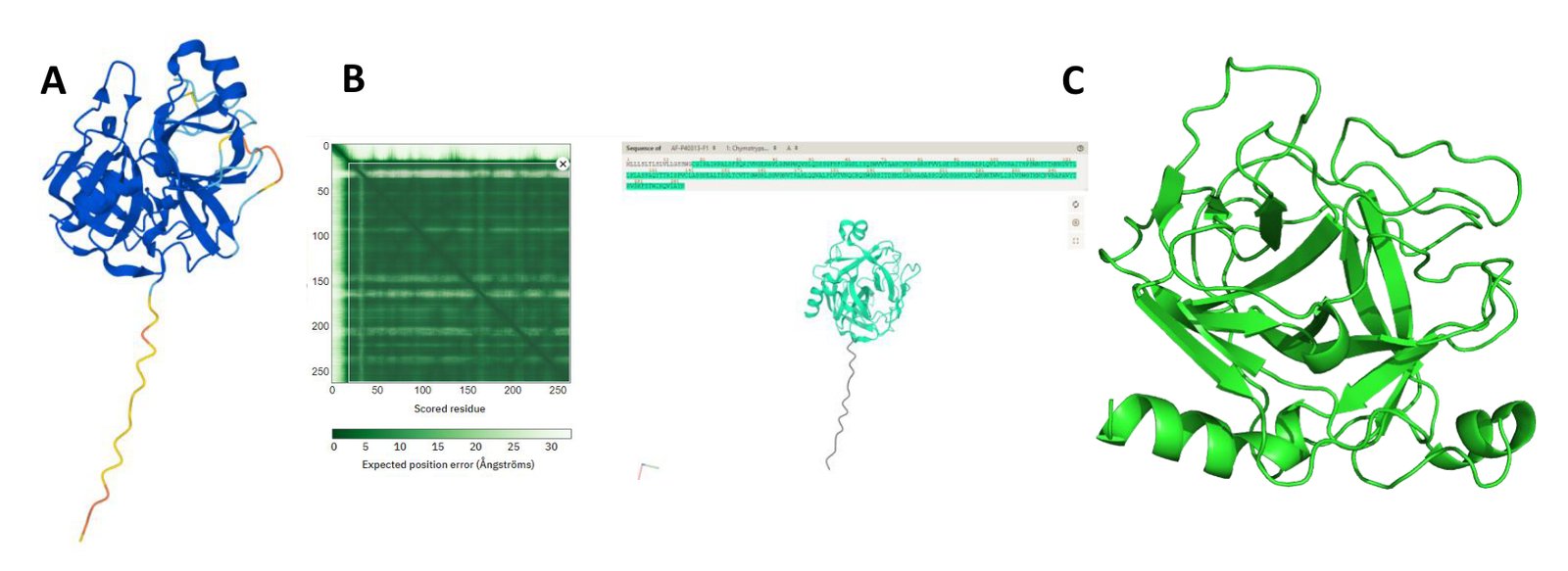
The AlphaFold2 model of P40313 (A) with its predicted aligned error (B), and the model after removing the low-confidence signal peptide (C). The PAE panel is the one that governs interpretation: it says which parts of the model can be trusted relative to which.
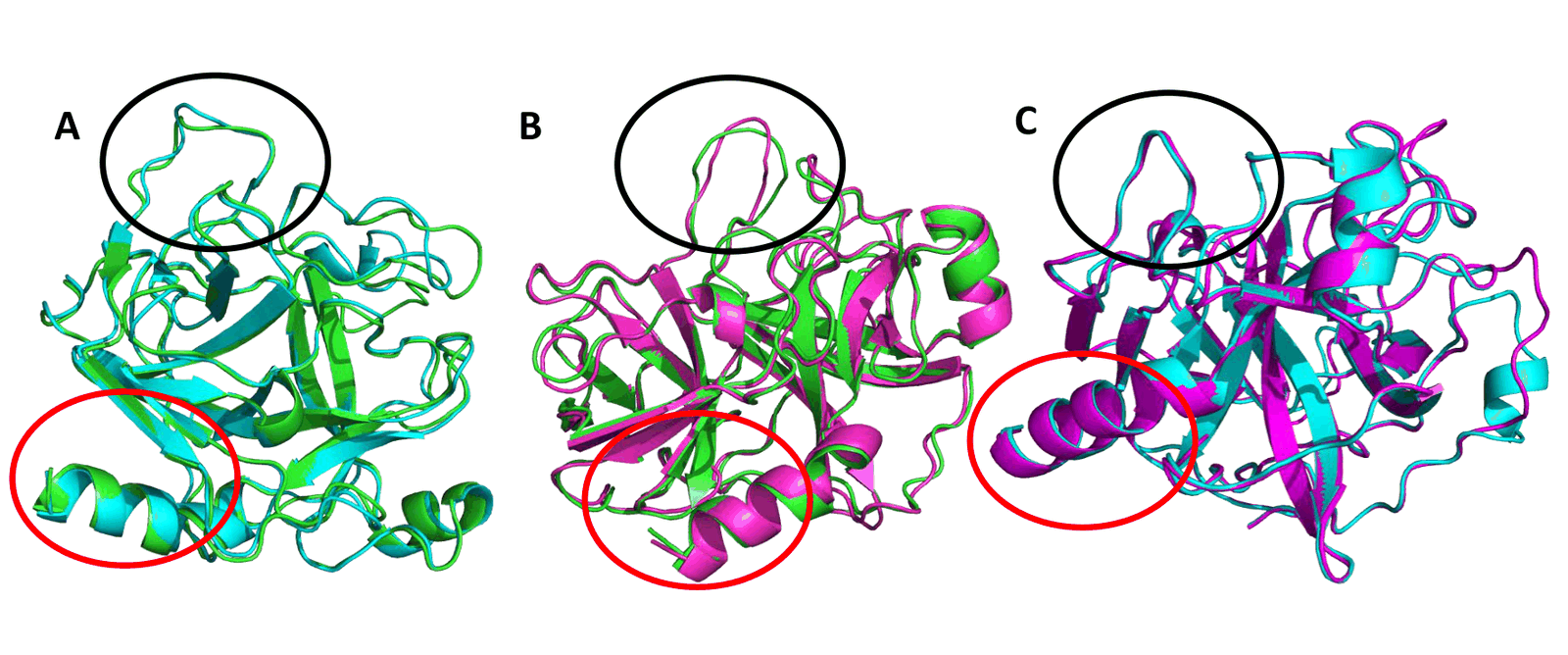
Superposition in PyMOL. AlphaFold2 (green) against the automated SWISS-MODEL model (blue, A) and the alignment-based model (pink, B), and the two template models against each other (C). Loops, circled in black, diverge; helices and sheets, circled in red, agree.
The two template-based models agree closely (RMSD 0.287). AlphaFold2 sits nearer the automated model (0.478) than the alignment-based one (0.514). All the disagreement is in loops, which is where homology modelling is least constrained, while the secondary structure and the active site superimpose.
Judging the models
Appearance is not evidence, so the models were scored:
- QMEANDisCo 0.81 for both template models against 0.75 for AlphaFold2.
- QMEAN -0.04 for the alignment-based 1ACB_E model against -0.23 for the automated one.
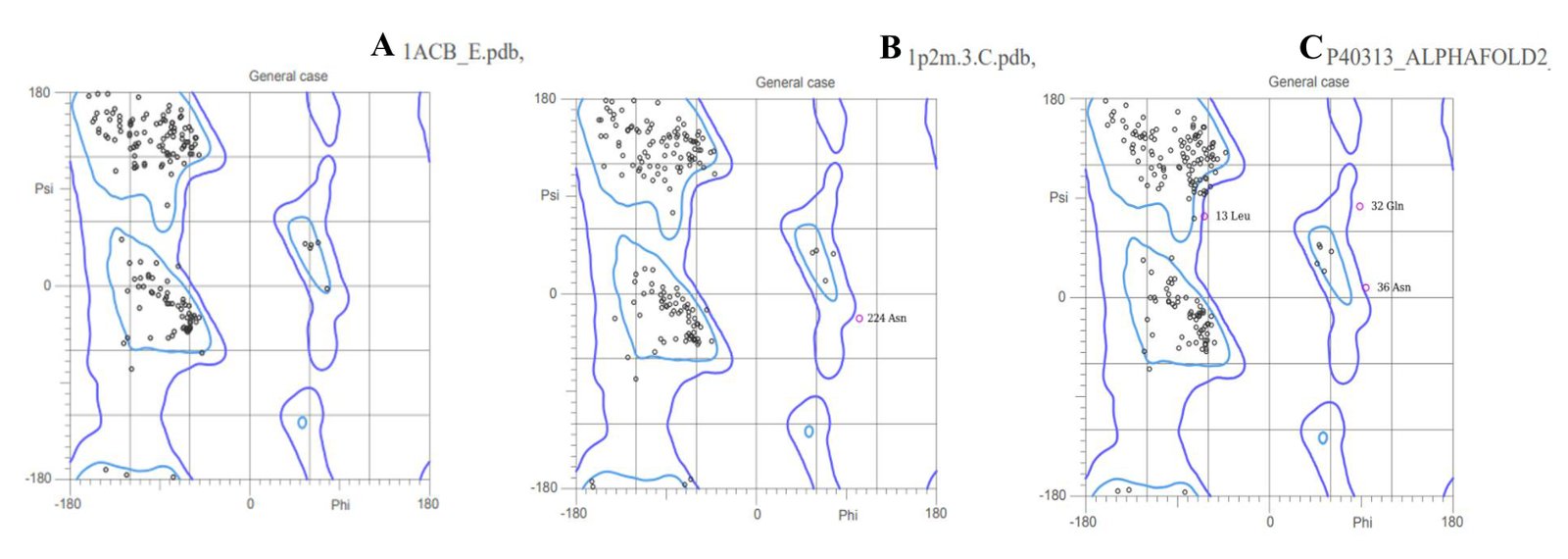
Ramachandran plots from MolProbity for the alignment-based model (A), the automated model (B) and AlphaFold2 (C). The alignment-based model has no residues in disallowed regions; the automated model has one (Asn224) and AlphaFold2 has two non-glycine outliers.
The conclusion is a split decision, which is the interesting part: the alignment-based model scored best on QMEAN and Ramachandran, while the automated model was the one closest to AlphaFold2. Agreement with a neural network is not the same as stereochemical quality.
Function
InterPro, Pfam and MEROPS place CTRL-1 as an S1A peptidase with the chymotrypsin fold, a serine endopeptidase. The models position its His, Asp and Ser catalytic triad at residues 75, 121 and 214, three residues far apart in sequence but adjacent in space.
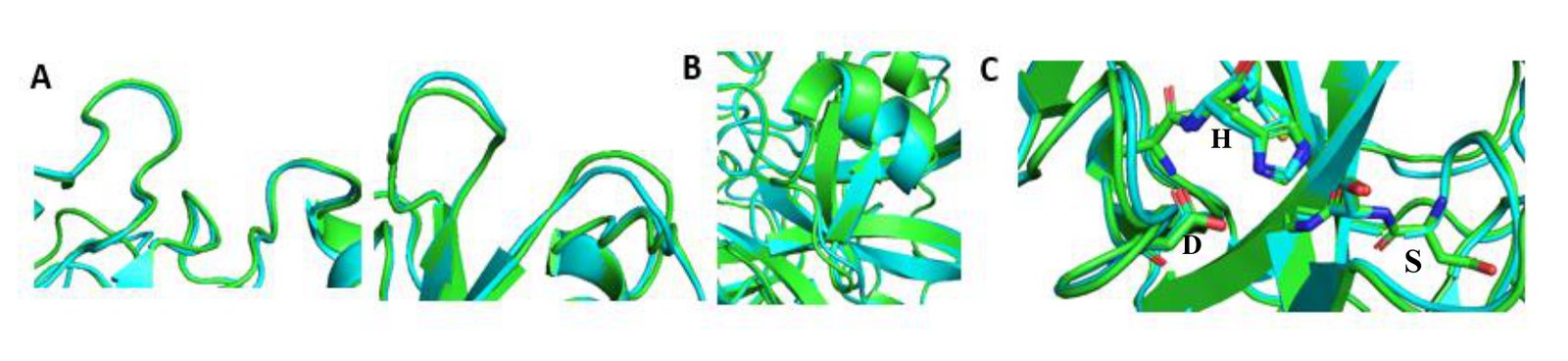
Close-ups of the two template models: a divergent loop (A), a helix (B) and the His, Asp and Ser catalytic triad (C).