Computer Vision Prototyping for Intra-Operative AI
A summer internship as AI Surgical Devices Intern at Touch Surgery in London, five months before the company was acquired by Medtronic for $300M in February 2020.
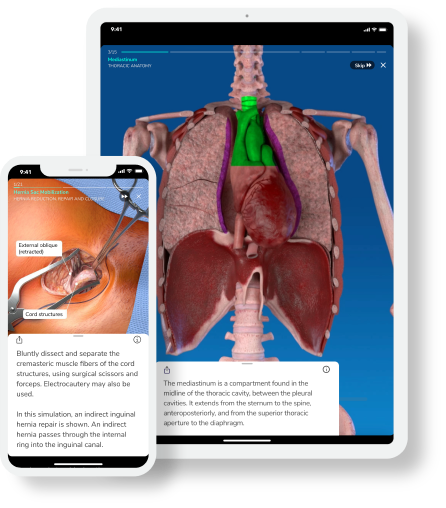
The product the computer vision work sat alongside: interactive, step-by-step surgical simulations with annotated anatomy. The same understanding of what is happening in a procedure, and where the anatomy is, is what an intra-operative model has to recover from video.
The problem
Touch Surgery’s ambition was remote and tele-mentored surgery: a senior surgeon guiding or assessing an operation they are not physically present for. That only works if software can understand the operative video in something close to real time, recognising the instruments in view, the anatomy, and which step of the procedure is under way. A remote surgeon watching an unannotated video feed has no more information than a bystander.
What I worked on
I built computer vision prototypes in OpenCV with CUDA acceleration, working on intra-operative video, and handled pre-training and testing for the models behind them.
Surgical video is an unusually hostile domain for vision models. Illumination changes as the scope moves, smoke from cautery obscures the field, blood alters the colour distribution mid procedure, instruments occlude one another, and the camera itself is handheld and moving. Frames are also heavily correlated in time, so a naive train and test split leaks: adjacent frames from one operation end up on both sides of it and the reported accuracy is meaningless. Splitting by procedure rather than by frame is what makes an evaluation honest, and that is the kind of detail that decides whether a result is real.
CUDA mattered for the same practical reason: the target was intra-operative use, so inference that cannot keep pace with a live video feed is not a solution regardless of its accuracy.
Alongside the modelling I contributed to data infrastructure improvements and to the validation protocols used to assess surgical AI, which in a clinical device context is not a formality but the thing the eventual regulatory case rests on.
Due diligence
I also observed key operational and due diligence activities in the period preceding the acquisition. Watching an acquirer stress-test a company’s technical claims, its data provenance and its regulatory position was an early and unusually direct lesson in how technology is actually valued, and it is a large part of why I later moved towards venture capital.