Computational Biologist, then Junior ML Engineer, Nucleome Therapeutics
Work at Nucleome Therapeutics, an Oxford immunology company using non-coding human genetics and 3D genomics to find drug targets for inflammatory disease.
I joined in September 2024 as a Computational Biologist, working on the data acquisition and processing behind the in-house target-information portal, and moved into the ML team in January 2025 as a Junior ML Engineer. The two strands below follow that progression, and were presented to the lab in September 2025 as Computational data challenges, solutions and lessons.
Part 1: Application development (Computational Biologist)
The goal was that for a given external data source, the in-house portal should reproduce its web-page content and plots exactly as shown, prepared so it loads and formats efficiently. Each source resisted in a different way.
DepMap, gene knockout survivability. The files were fragmented and the derivation of the survivability labels was undocumented, despite the graphs on the site clearly being generated from something. The answer was in the forums: an undocumented API endpoint returning the gene dependency summary, from which the CRISPR (Chronos) and RNAi (Demeter) essentiality and selectivity calls could be reconstructed. Lesson: read the forums.
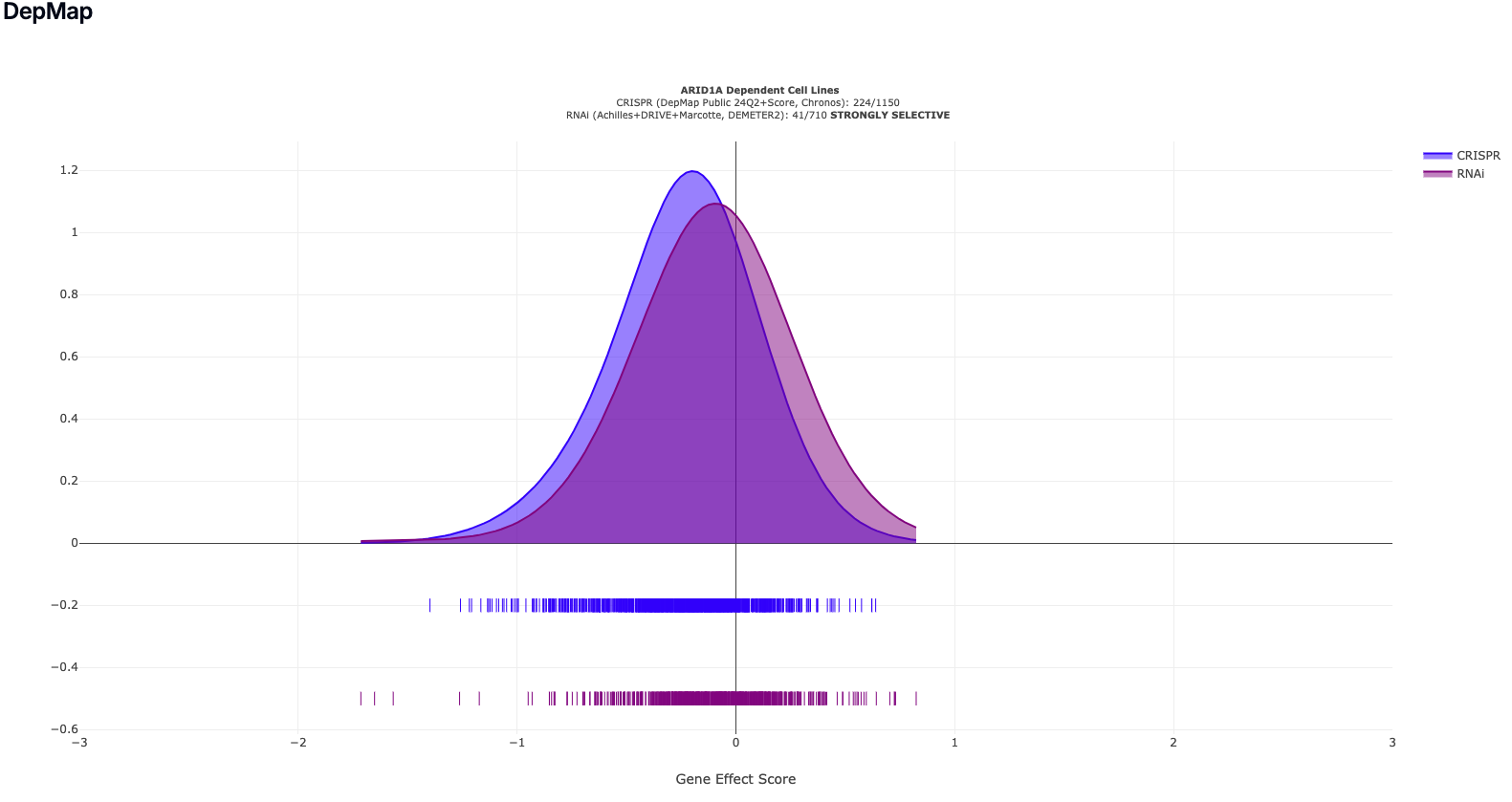
ARID1A dependency across cell lines, with the CRISPR (Chronos) and RNAi (DEMETER2) distributions and the selectivity call recovered from the undocumented endpoint.
GTEx, tissue expression. 54 separate TPM files, roughly 60,000 genes by 1,000 samples across 54 tissues, which is over three billion data points and far too wide to plot from directly. The solution was to scrape and process the 54 files automatically, then concatenate and pivot them into a single long-format Parquet file with tuned row groups. The columnar layout compresses repeated gene and tissue IDs into a metadata dictionary, and lets the query engine skip whole row groups that cannot contain the gene being asked for. Row-group size was tuned between 128 MB and 512 MB, since larger groups mean less fragmentation but weaker skipping.
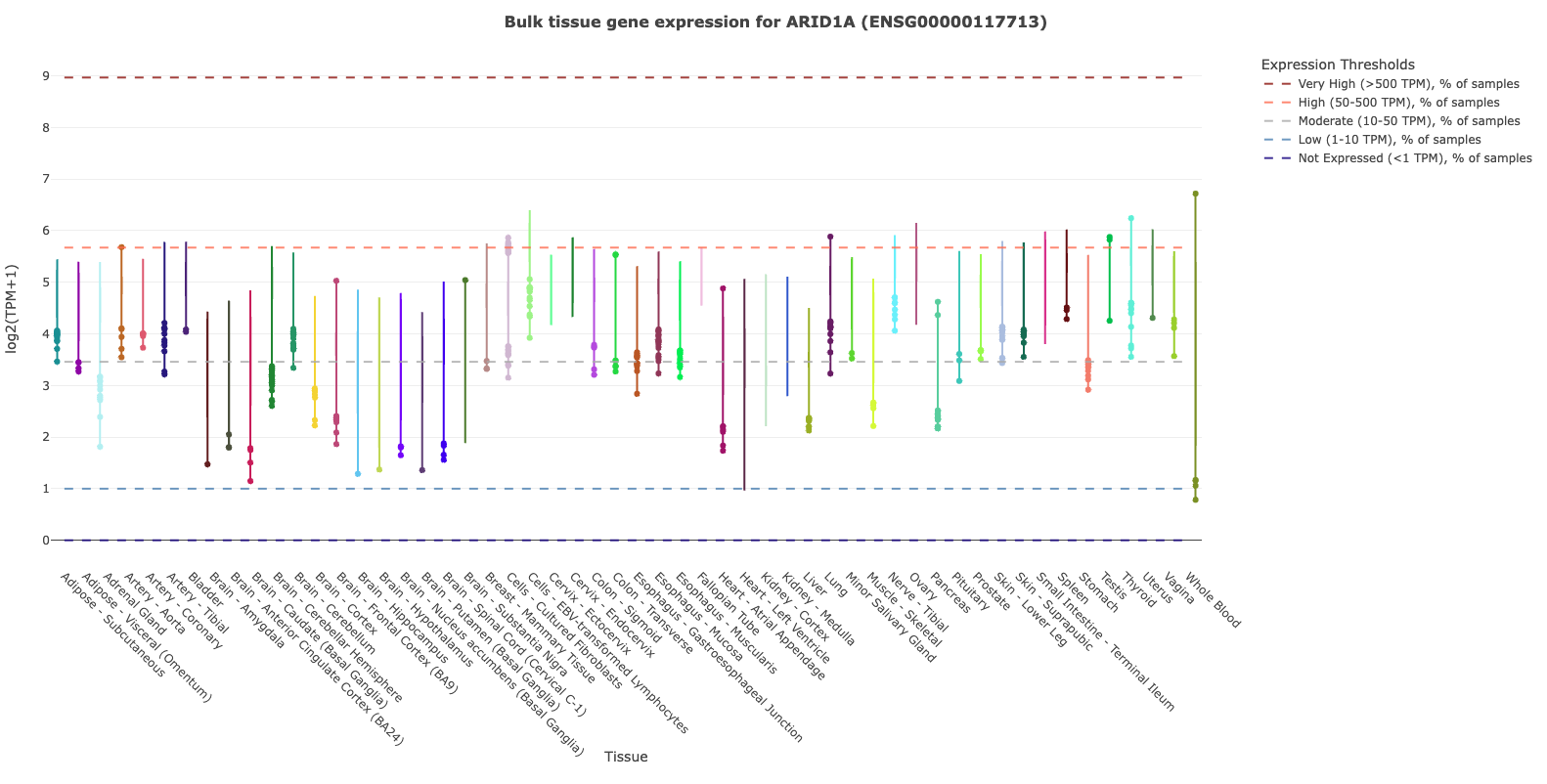
Bulk tissue expression for ARID1A across all 54 GTEx tissues, served from the pivoted Parquet store. Every point is one sample, drawn from a corpus of over three billion.
HPA, cell type expression and protein summary. No data files existed for the curated protein summaries, which are assembled from many upstream sources. Since the pages are static HTML, a BeautifulSoup scraper walking one URL per gene was enough. The contrast with GTEx is the useful part: GTEx is a dynamic, JavaScript-driven page where the data only appears after interaction, so it needed Selenium to simulate the click-and-download sequence across nine pages.
ChEMBL, drug and molecule availability. A PostgreSQL schema complex enough to take weeks or months to learn by hand. Instead: dump the schema alone (pg_dump -s), feed that blueprint to an LLM, and have it work out the join path from a gene target through to the approved molecules associated with it. A relational schema is a city, where tables are buildings, keys are addresses and joins are the routes between them, and the model is good at finding routes.
Single-cell RA/SLE atlas. Seurat and Scanpy are too heavy for the portal, which can only serve flat files. So the AnnData object was taken apart into its useful pieces: cell metadata from .obs, UMAP coordinates from .obsm, and the normalised expression matrix from .layers, converted from a sparse matrix to Parquet. The package’s plots were then re-created from those flat files directly.
Part 2: Machine learning and functional validation (Junior ML Engineer)
Fine-tuning genomic foundation models
DeepHaem, the convolutional architecture behind this work, predicts whether chromatin is open or closed for a given 1 kb DNA sequence, trained on ATAC-seq and DNase-seq accessibility data. At inference it performs in silico mutagenesis: take a 1 kb window centred on a SNP, mutate the middle base to the alternate allele, and score both sequences. The difference, called the damage score, says whether the variant is predicted to close chromatin (loss of function) or open it (gain of function), per cell type.
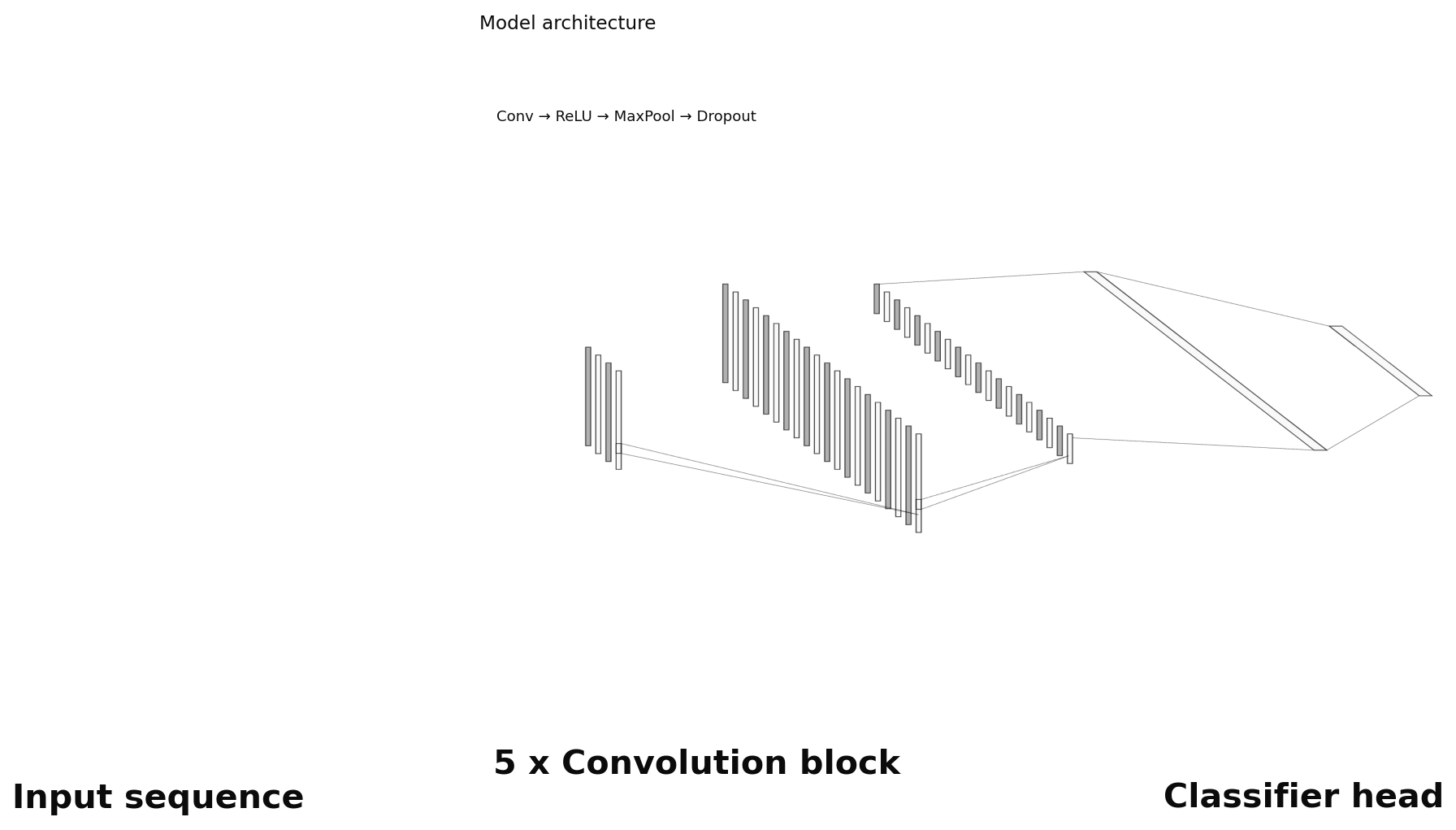
The published DeepHaem architecture: a 1 kb input sequence through five convolution blocks, each Conv, ReLU, MaxPool and Dropout, into a classifier head. Published in Schwessinger et al., Nature Methods 2020.
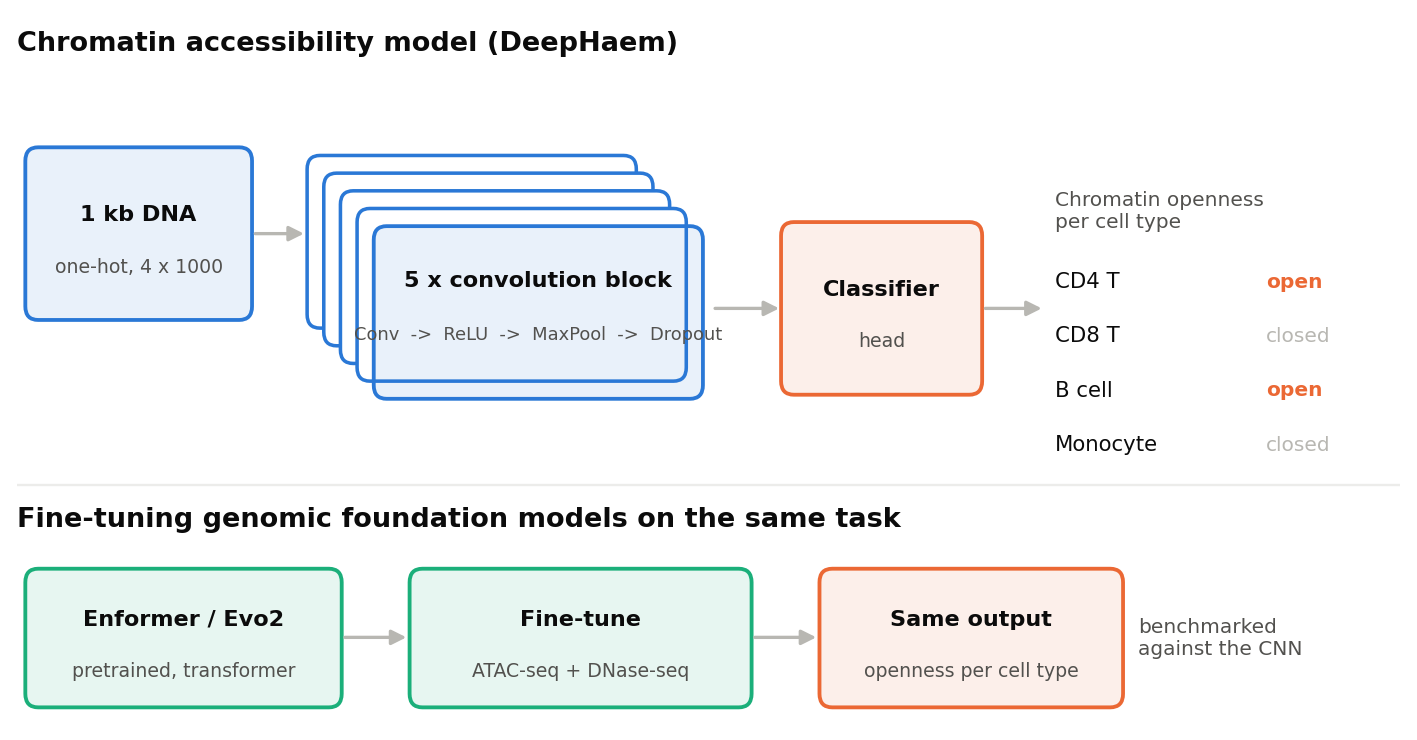
The same model in schematic form, with the parallel question underneath: whether a pretrained transformer, fine-tuned on the same assays, does better than a convolutional network trained from scratch. The classifier head predicts openness separately for every cell type.
A parallel line of work asked whether a general-purpose genomic foundation model, fine-tuned on the same accessibility assays, could beat a bespoke architecture trained from scratch. I fine-tuned Enformer and Evo2 on the ATAC-seq and DNase-seq data to benchmark them against DeepHaem. The appeal is that these models arrive already carrying a representation of regulatory sequence learned at far greater scale than any single in-house training set, so the fine-tuning question is how much of that transfers to a specific accessibility prediction task.
The validation problem
None of these predictions had a gold standard to validate against. Damage scores are deterministic computational outputs with no p-values, so there was no way to tell a good model from a bad one, or to know whether a threshold was meaningful. Without that, comparing DeepHaem against a fine-tuned Enformer or Evo2 is guesswork.
Allelic skewing as ground truth
In a heterozygous patient, both alleles sit in the same cell under identical conditions, differing by a single base. During ATAC-seq the transposase can only reach open chromatin, so an imbalance in reads between the two alleles is direct experimental evidence that the variant affects accessibility.
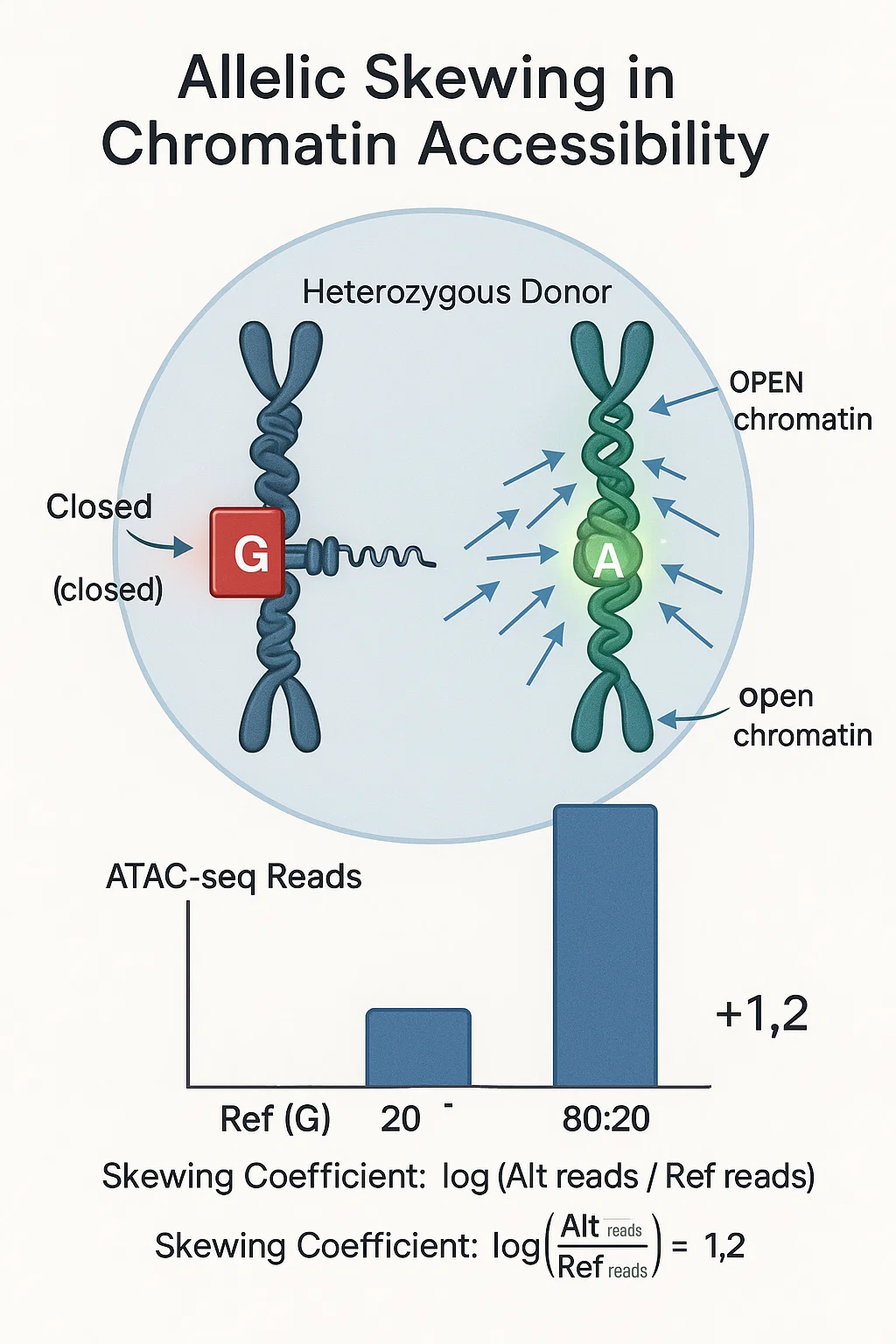
After quality filtering, meaning minimum read coverage, consistency across replicates, and a significance test against the 50:50 null, only about a third of SNPs survive. Those that do reflect real biology rather than statistical noise.
Matching model inference against the filtered skewing data across B cells, CD4 and CD8 T cells, NK cells, classical monocytes and macrophages gave a confusion matrix, and from it an odds ratio measuring enrichment over random chance. That single number made model versions comparable for the first time, and immediately earned its keep by exposing an indexing bug in one model generation that had until then been invisible.
Key takeaways
- There is almost always a way to get the data you need. Check the forums, and if it isn’t published, it can usually be scraped, especially from a static page.
- If data can be stored as Parquet, store it as Parquet. The compression and query times are not close.
- LLMs are genuinely useful for the tedious parts, like learning an unfamiliar database schema.
- Sometimes you have to re-invent the wheel. Just make sure it’s worth the time first.
- Imperfect validation beats none. Skewing rests on assumptions, but it diagnosed a poor-performing model that nothing else had caught. A negative result is still a result.